Buy the thermometer you will actually pick up every time, not the one with the longest spec sheet. A reading you trust in a couple of seconds beats a precise one you have to hunt for, squint at, or wait on while the grill lid stays open.
That sounds obvious, but most of the choices below come back to it. Speed, probe length, display, and water resistance each decide whether the tool stays in the drawer or ends up in your hand. For each one, there is a check you can run in a store or in the first few minutes after the box arrives.
What actually matters
Reading speed
Speed is the whole point of the category. A thermometer that takes many seconds to settle forces you to hold your hand over hot coals or a bubbling pot while you wait. It also tempts you to read early, before the number has stopped moving.
The check: watch the number after the probe goes in. A good one climbs quickly and then stops. If it keeps creeping, you are being asked to guess the final value. Makers usually state a reading time, so compare those claims, and read owner comments for whether the real-world behavior matches.
Speed matters more for grilling than for oven roasts. On a grill you are checking many pieces, often with the lid up and flare-ups nearby. In candy work the temperature can shift quickly, so a slow reading tells you where the syrup was, not where it is.
Accuracy
Accuracy is stated as a plus-or-minus figure in degrees. Smaller is better, and it is worth reading, but a stated number is only useful if the thermometer stays true over time. That is why a calibration function counts for more than a slightly tighter spec.
The check: put the probe in a glass packed with ice and just enough cold water to fill the gaps, then stir. Wait for the number to settle. It should read freezing. If it is off by a clear margin, you need either a calibration function or a different thermometer. Boiling water is a second check, but the boiling point shifts with altitude, so treat that one with caution.
Third-party certification, such as NSF, tells you the design has been reviewed against a food-safety standard. It does not replace the ice test.
Probe length
Length is a trade-off, and it is the factor people think about least. A short probe keeps the thermometer compact, but it puts your fingers closer to heat and steam. A long probe reaches the center of thick cuts, but it is awkward to fold away and harder to use in a shallow pan.
For grilling thick steaks, chops, and whole pieces of poultry, you want enough length to reach the center from the side while your hand stays clear of the grate. For candy, the concern is different. You need to submerge the tip in the syrup without touching the bottom of the pot, and you want your hand well back from the steam.
The check: look at the stated probe length and imagine it against your thickest cut and your deepest pot. If you cook large roasts or whole birds, shorter probes will make you angle the tip in awkwardly.
Also look at the tip. A thin, tapered tip leaves a smaller hole in the meat and registers the temperature at its very end, which is what you want.
Display
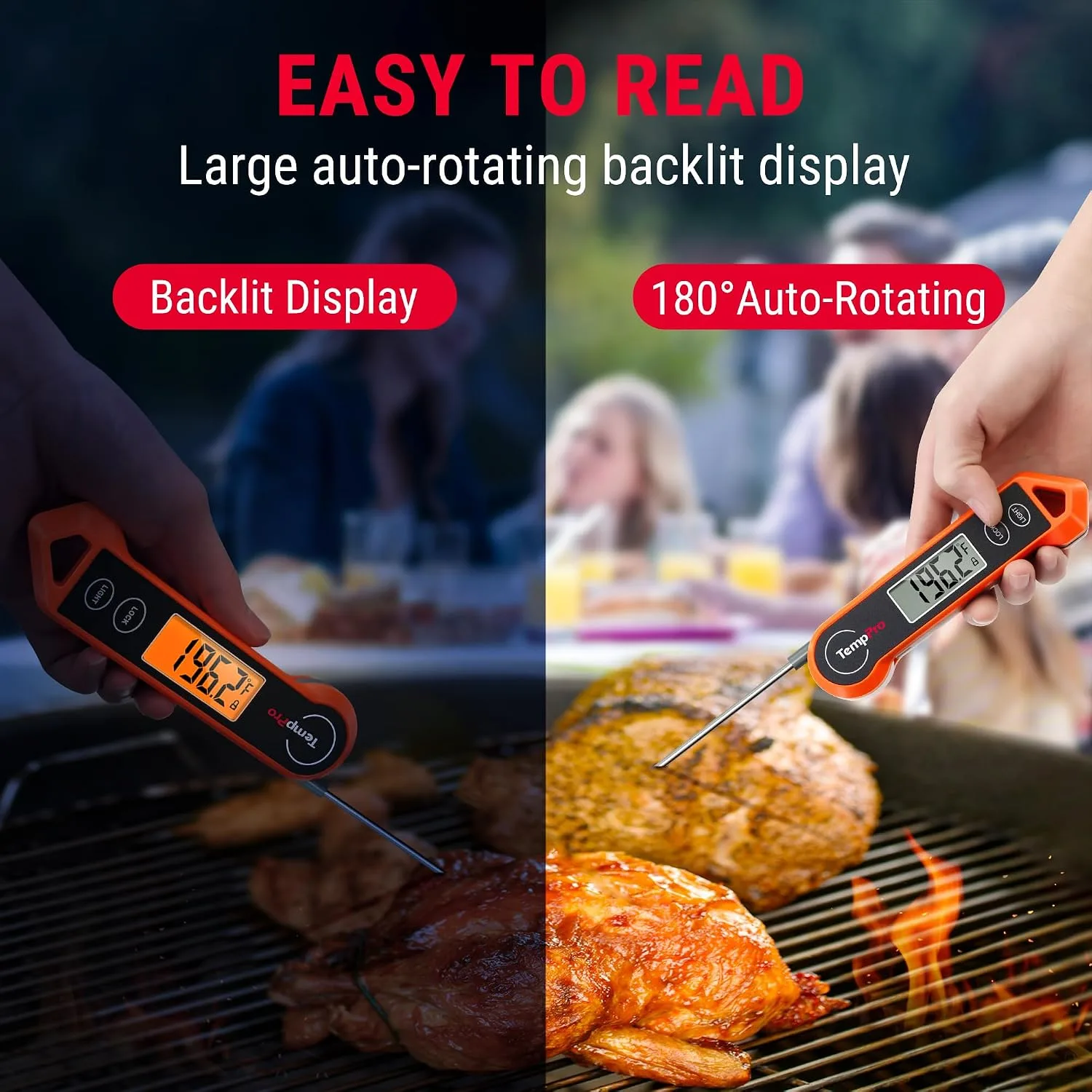
Backlighting and digit size are not luxuries. Grilling happens at dusk, under a patio light, or in smoke. Candy happens with steam rising off the pot. A small, dim, fixed screen turns every reading into a squint.
The second display question is orientation. A fixed screen works fine until you hold the thermometer left-handed, or reach across the grill, or approach a pot from the wrong side. Then the numbers are upside down. Screens that rotate solve this, and some do it automatically.
The check: hold the thermometer the way you would actually use it, with the probe pointed down into a pot or sideways into a piece of meat. Can you read it without tilting your wrist? Try it left- and right-handed, even if you are only one of those.
Water resistance
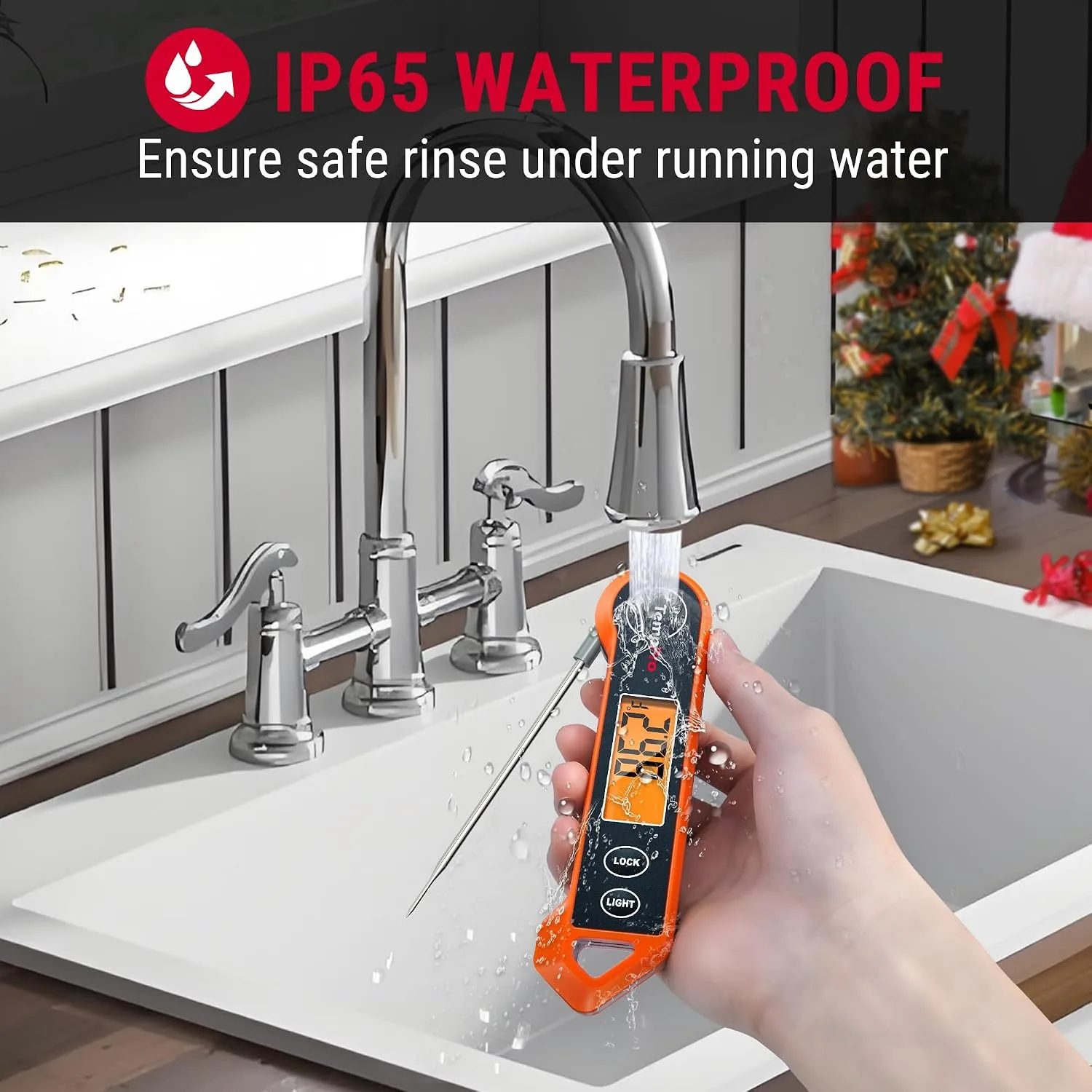
Kitchen thermometers get splashed, rinsed, and set down in wet spots. Some water resistance is a reasonable thing to ask for. The details matter, though. A water resistance rating usually means the body can handle splashes and a rinse under the tap. It does not mean the thermometer can be run through the dishwasher or left in a sink of soapy water.
The check: find the stated rating, and then read the care instructions. Many thermometers with a good rating still say hand wash only. That is fine, but know it before you buy so you do not cook the electronics in a hot dishwasher cycle.
Power and wake behavior
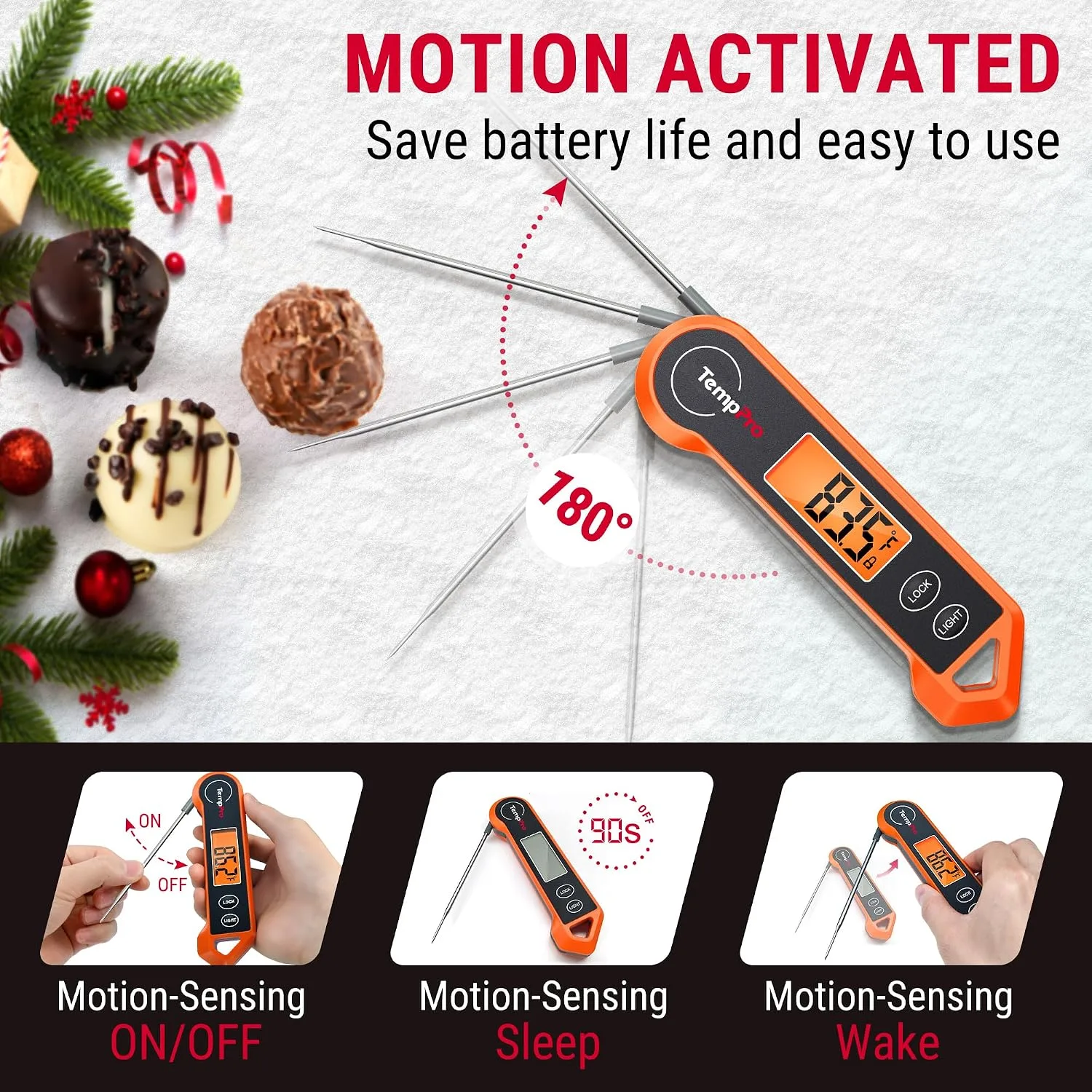
This is the unglamorous factor that decides how often you are annoyed. Thermometers that need a button press to wake up are fine, but they add a step. Models that wake when you unfold the probe and sleep when you close it save a step and save the battery.
Check what battery it uses and whether one is included. Common cell types are easy to find in a pinch. Coin cells are also easy to find, but they are less convenient to swap while you are mid-cook.
The check: look for whether the thermometer turns itself off after inactivity. If it does not, you are the auto-off, and you will forget.
Hold and calibrate controls
A hold function freezes the reading on screen so you can pull the probe out of a hot pot or a smoky grill and read it somewhere comfortable. It is a small feature that earns its place quickly. Calibration, as covered above, is what keeps an older thermometer honest.
What to ignore
- App connectivity on an instant-read. Instant-read thermometers are for spot checks. If you want to watch a roast from the couch, that is a different tool, a leave-in probe. Skip wireless features you will not use on a tool you hold in your hand.
- Huge, unexplained temperature ranges. A wide range sounds impressive, but what matters is whether the range covers the cooking you do. Check it against your candy recipes and your highest grill temperatures.
- Color options and styling. A bright body is actually useful, since it is easier to spot next to a cutting board. Beyond that, finish and color do not change how well it reads.
- Preset meat charts as a deciding factor. A printed temperature guide on the back is handy, but you can look up doneness temperatures anywhere. Treat it as a bonus.
- Storage extras as a primary reason to buy. A magnet, a hook hole, or a sheath helps you find the thing, but they should not outweigh speed, accuracy, and readability.
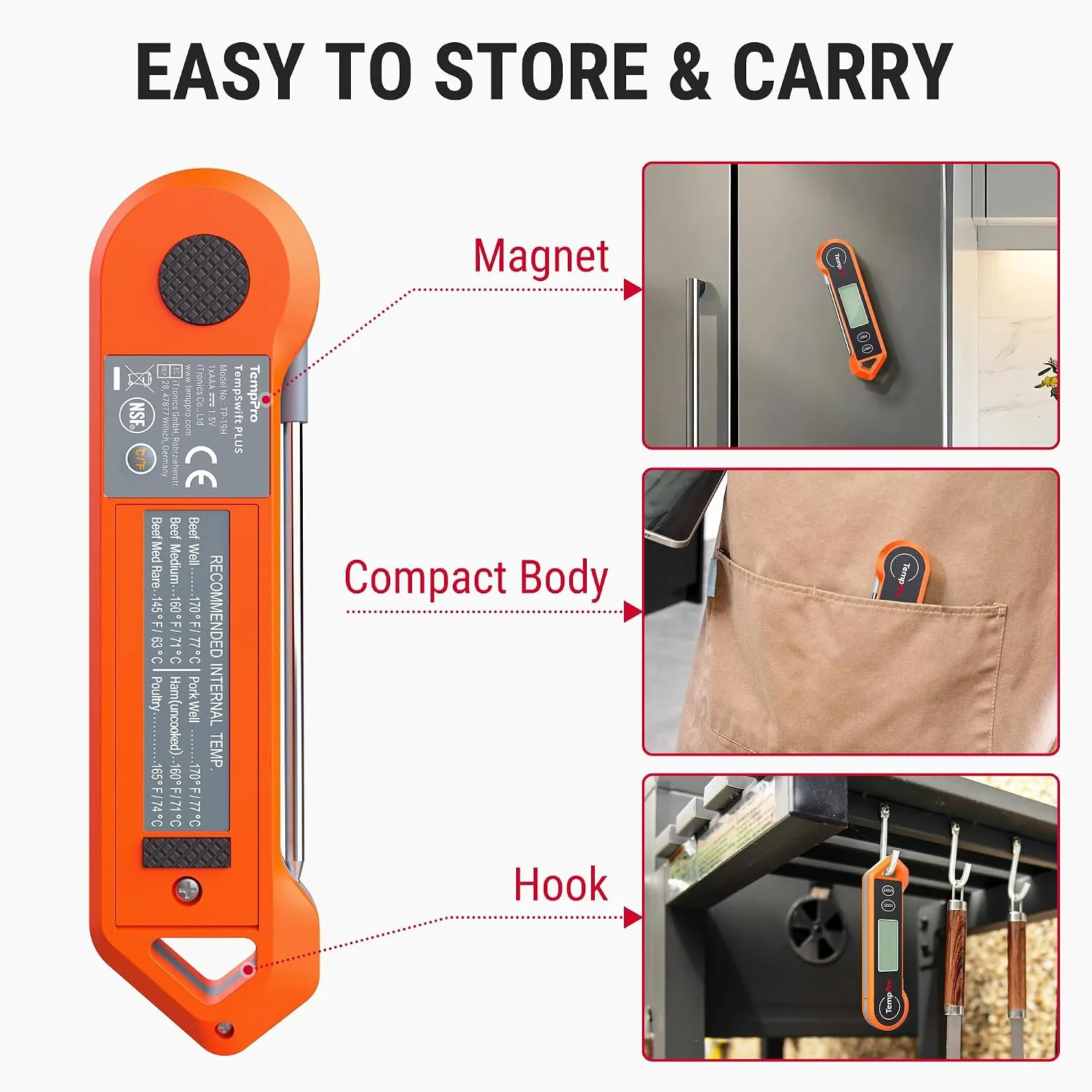
Storage is worth a moment of thought, though. A thermometer that lives in a drawer under other tools tends to get banged around. One that clips to a hook or sticks to the fridge is more likely to stay close and stay intact.
Common mistakes
- Reading too early. Pushing the probe in and taking the first number is the classic error. Wait for the reading to stop moving before you trust it.
- Touching bone, fat, or the pan. Bone and the pan conduct heat differently from the meat. Keep the tip in the thickest part of the meat, away from bone, and in candy keep it off the bottom of the pot.
- Checking only one spot. Meat cooks unevenly. On a big roast or a whole bird, check more than one location, and trust the lowest reading.
- Skipping calibration. Dropping a thermometer, or just using it for a long time, can shift it. The ice test takes a minute. Run it when it arrives and again now and then.
- Treating water resistance as dishwasher safe. Resistance to splashes is not the same as being built for a wash cycle.
- Using the same tool for everything without cleaning. Wash the probe between raw and cooked checks. This is basic food safety, and it matters more with a probe you move from raw meat to a finished piece.
Which buyer should pick what
The weeknight griller
You are checking chicken thighs, burgers, and steaks, often outdoors with the lid up. Prioritize reading speed, a lit display, and a probe long enough to keep your hand away from the grate. A rotating screen is a real help when you reach across the grill.
The holiday roaster
You cook large cuts a few times a year. Probe length and the ability to check several spots matter most. Storage matters too, because a tool you use rarely tends to get lost, so a magnet or hook is a sensible tiebreaker.
The candy maker
You need a thermometer that reads quickly as temperatures change, a probe that lets you keep your hand clear of steam, and a stated range that covers your recipes. Calibration matters more here than anywhere else, since recipes can fail when the number is off.
The one-tool kitchen
If you want a single thermometer for grilling, roasting, and candy, look for the overlap. Fast reading, readable display, some water resistance, and a calibration function cover most of what each of those jobs asks for.
The serious barbecue cook
If you smoke large cuts for many hours, an instant-read is a companion, not a replacement. You will probably want a leave-in probe as well, and the instant-read becomes the tool for spot checks and verifying that the leave-in is correct.
Where our catalog product fits
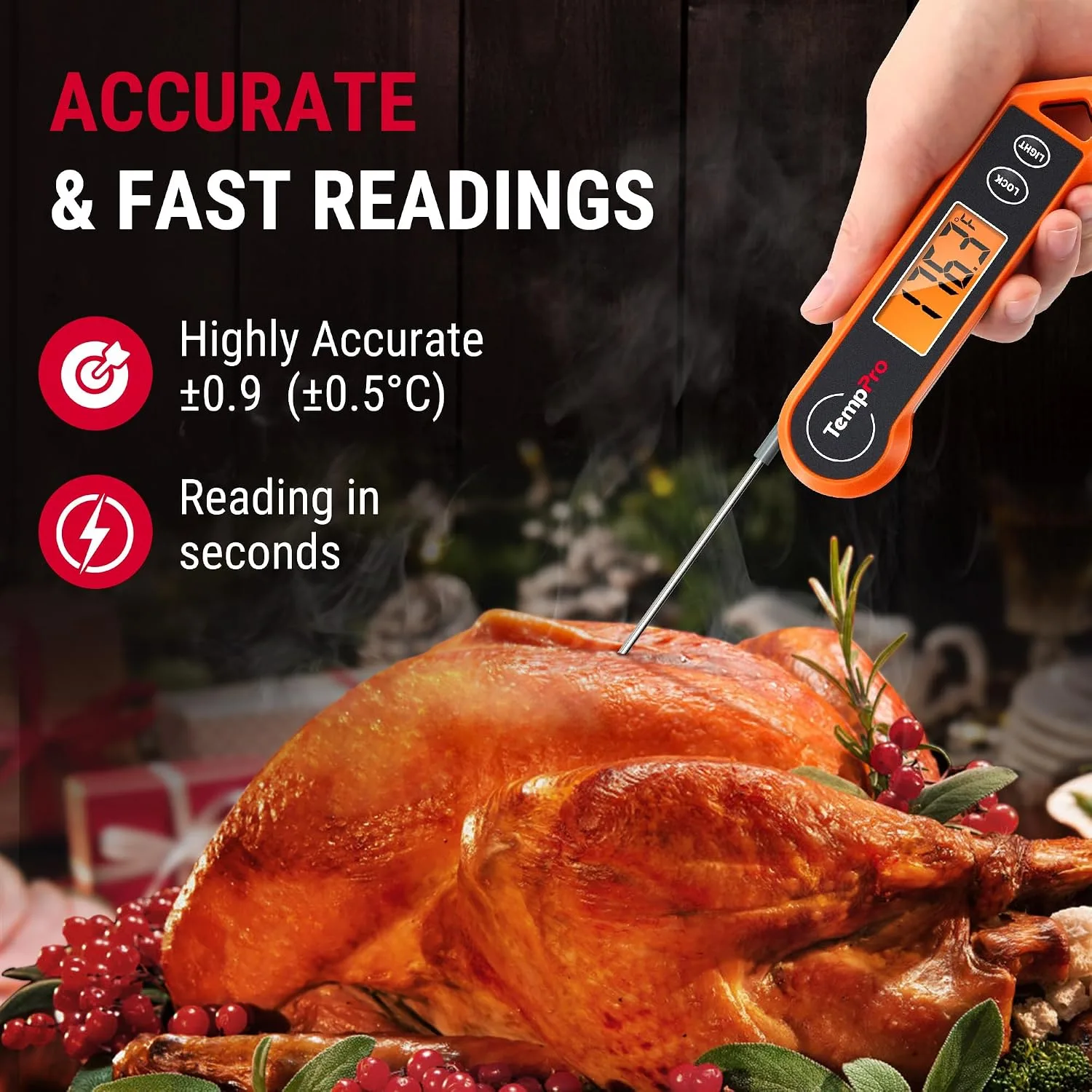
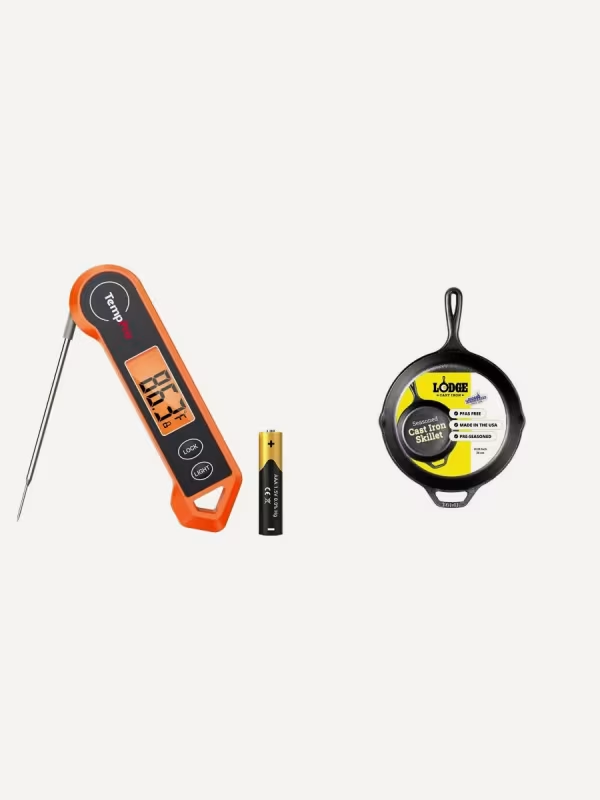
The TempPro TempSwift TP19H is a fold-out probe thermometer built for the grill, roast, and candy buyer described above. It reads in about one second with a stated accuracy of ±0.9°F, and it carries NSF certification. The probe is 4.3 inches of stainless steel.
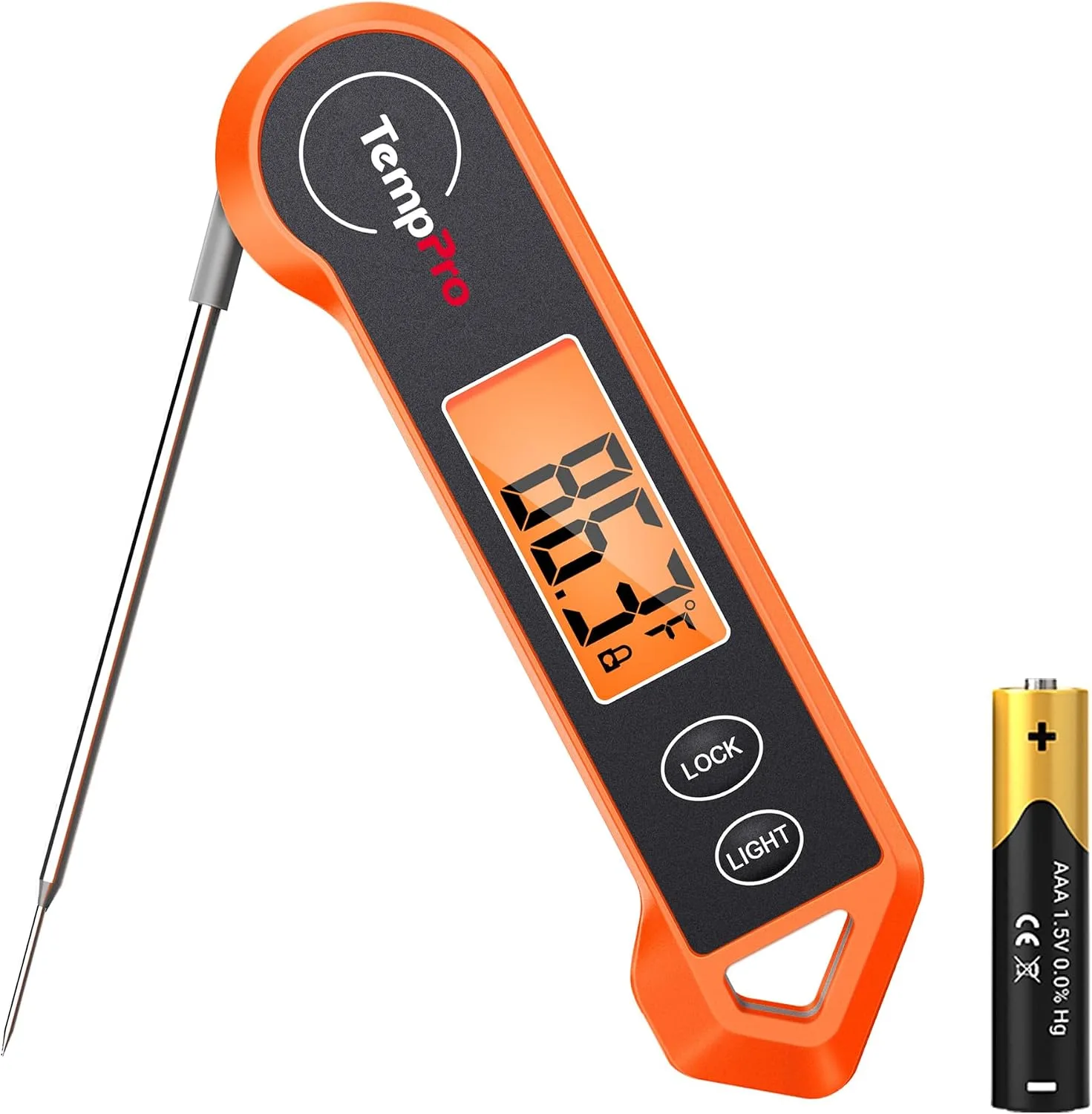 TempPro TempSwift TP19H Instant Read Meat ThermometerTempPro · TP19H4.7/5
A fold-out probe thermometer that reads in about a second, wakes when you open it and sleeps when you close it. Owners praise accuracy and the display; durability reports are mixed.
As an Amazon Associate we earn from qualifying purchases. Links on this page may be affiliate links; we may earn a commission at no extra cost to you.
The screen is a 2.0 inch backlit display that rotates to face left- or right-handed users, which addresses the orientation problem covered earlier. It powers on when the probe opens and sleeps after inactivity, so there is no button to remember. It runs on one AAA battery, and one is included.
It also has a lock function to hold a reading on screen and a calibration function for recalibrating when needed. The IP65 water resistance means you can rinse it under the tap. Hand washing is the stated care method, so keep it out of the dishwasher. A magnetic back and a hang hole give you two ways to store it.
Owners call it accurate and fast, and some like the large numbers that are easy to read in the dark. Some use the magnetic back to keep it on the fridge. The mixed point is durability. Some owners report using theirs for years, while others report it failing. If you buy it, run the ice test early so any problem shows up right away.
Probe length is the main trade-off to weigh. At 4.3 inches, compare it against the thickest cut and deepest pot you cook with. If your cooking leans toward very large roasts, think about whether you are comfortable reaching the center with that length.
It is a good match for anyone who grills, roasts, or makes candy and wants a fast reading. Check the current price before you decide.
Found this review helpful?
Pin it to one of your boards and come back to it whenever you need a reminder.

No comments yet.
Join the discussion. Comments are moderated before appearing.