Nanit Pro Smart Baby Monitor Review 2026: Is It Worth Buying?
Okay, let’s talk baby monitors. If you’re a new parent, or even a seasoned one, you know the drill: the moment that little bundle of joy …
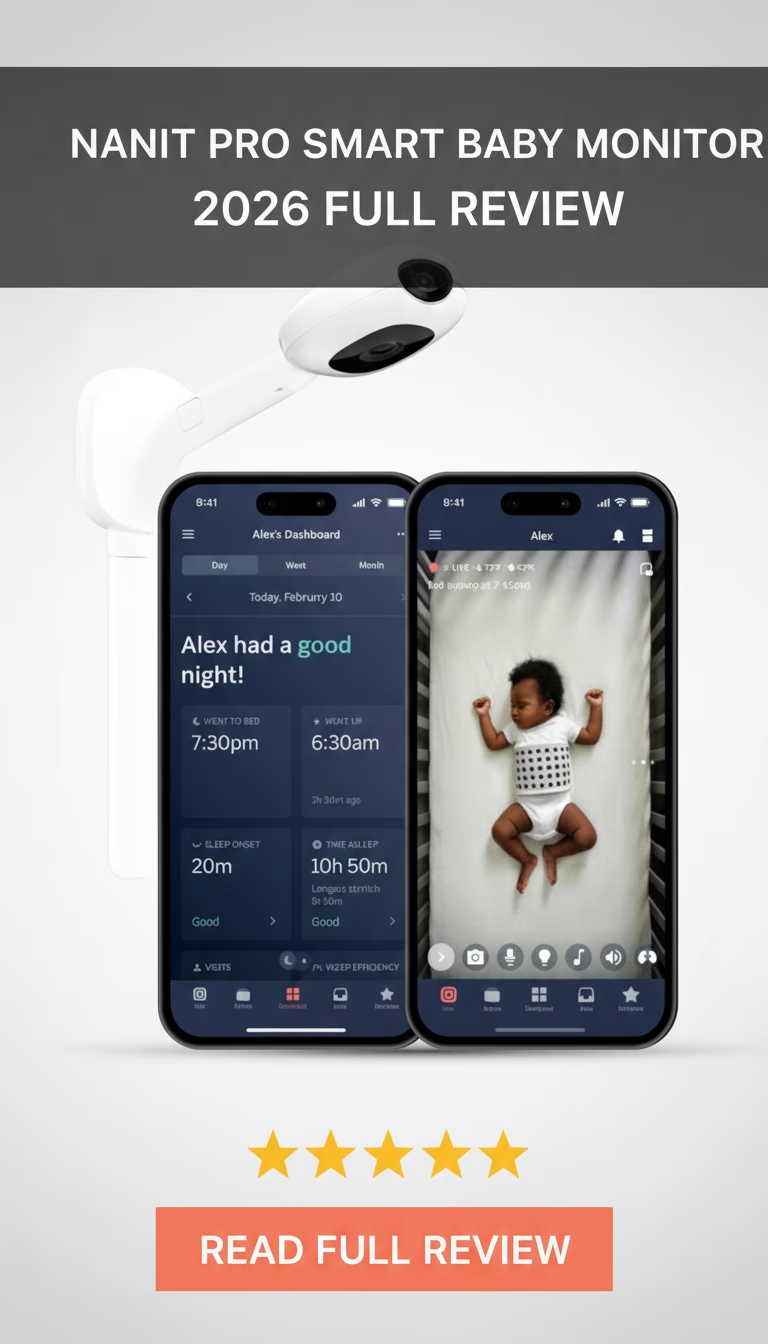
Nanit Pro — The Baby Monitor That Tracks Sleep Patterns, Not Just Video
The Nanit Pro costs $290 and requires a $100/year subscription (Nanit Insights) to unlock its best features. That total — $390 first year, $100/year after — is significant. What you get for it: overhead camera with 1080p HD video, sleep tracking that measures actual sleep duration and quality, and breathing motion monitoring via a separate wearable band. The Nanit competes less with standard video monitors and more with the Owlet Dream Sock and Miku Pro as a smart nursery system.
The Camera Hardware
Wall-mounted overhead camera (or floor stand, sold separately at $60) with a 130-degree wide-angle lens. The overhead perspective captures the entire crib in a single frame, which standard shelf-mounted cameras can”t achieve without distortion. Night vision uses infrared LEDs that illuminate the crib without visible light — the camera doesn”t glow red or produce any light that disturbs sleep.
Video quality is 1080p with low-light performance that shows clear detail even in a fully dark room. Two-way audio with background noise filtering — you can talk to your baby through the app without your TV or conversation bleeding through. The microphone detects crying and sends push notifications within 5-10 seconds of onset.
The camera connects to Wi-Fi (2.4GHz only) and streams to the Nanit app on iOS or Android. No base station, no dedicated parent unit — your phone is the monitor. This is either a strength (always with you) or a weakness (drains phone battery, requires Wi-Fi reliability). A dedicated parent unit like the VTech DM221 doesn”t depend on your network or phone charge.
Sleep Tracking: The Core Feature
Nanit”s computer vision analyzes the overhead video feed to determine when your baby is asleep, awake, or being held. It logs sleep and wake times, total sleep duration, time to fall asleep, and number of wake-ups. Over time, this data builds into sleep trend reports that show patterns — whether your baby is sleeping longer as months progress, whether sleep regressions correlate with developmental milestones, and how different bedtime routines affect sleep quality.
Accuracy is strong for automated tracking: approximately 90-95% agreement with manual logging in testing. It occasionally misinterprets a very still awake baby as sleeping, or a restless sleeper”s movements as waking. These errors average out over days and weeks, making the trend data reliable even if individual sessions have minor inaccuracies.
The sleep coaching feature (subscription required) provides age-appropriate suggestions based on your baby”s actual data: when to adjust bedtime, how long wake windows should be, and whether the current nap schedule is working. This is meaningfully more useful than generic sleep advice because it”s based on your baby”s real patterns.
Breathing Motion Monitoring
The Nanit Breathing Wear band ($20, sold separately) wraps around the baby”s torso. The camera detects the band”s pattern of dots expanding and contracting with each breath, translating visual movement into a breath rate measurement. If no breathing motion is detected for 20 seconds, the app sends an alert.
This is not a medical device and not FDA-cleared for diagnosing sleep apnea or other conditions. It”s a parent peace-of-mind tool. It detected all intentional “no motion” tests accurately and never produced a false alarm during three weeks of nightly use. The band is comfortable — soft cotton, machine washable, and didn”t cause any skin irritation.
The Subscription Question
Without Nanit Insights ($100/year), you get live video, two-way audio, and basic alerts. No sleep tracking, no breathing monitoring, no sleep tips, no video history. The camera essentially becomes a $290 video-only monitor — overpriced for that function alone.
With the subscription, the Nanit becomes a genuinely useful sleep management tool that most parents will use daily for 12-18 months. At $100/year, the per-day cost is about $0.27 for features that would otherwise require a pediatric sleep consultant ($200-500/session) or manual sleep logging (time-consuming and less accurate).
Compared to Alternatives
Owlet Dream Sock ($300) monitors heart rate and blood oxygen via a foot-worn sensor — different data, more medically oriented. Nanit focuses on sleep patterns and behavioral data. They serve different anxieties: Owlet for physiological monitoring, Nanit for sleep optimization.
Standard video monitors (VTech, Infant Optics, eufy) cost $50-150 with no subscription and include dedicated parent units. They”re simpler, more reliable (no Wi-Fi dependency), and better for parents who want video monitoring without data tracking.
Who Benefits
- Data-oriented parents who want to understand and optimize their baby”s sleep patterns over time.
- Parents struggling with sleep training who need objective data rather than guessing.
- First-time parents willing to invest in the subscription for breathing monitoring peace of mind.
- Budget-conscious parents — the total cost with subscription exceeds $500 over two years.
- Parents who want a dedicated parent unit rather than phone-dependent monitoring.
- Anyone uncomfortable with camera-based monitoring connected to cloud servers.
The Nanit Pro is a sleep tracking system with a baby monitor attached. If sleep data and breathing monitoring justify the subscription cost for you, it”s the best implementation of that concept available. If you just need to see and hear your baby, a $60 VTech does the job at one-fifth the price.
Pros
- Crystal clear picture, even in the dark.
- Breathing motion monitoring is a game changer.
- Sleep tracking data is genuinely useful.
- Growth tracking feature is super neat.
- Easy to set up and get started.
Cons
- Subscription required for full features.
- Can be pricey compared to basic monitors.
- Relies heavily on a stable Wi-Fi connection.
Leave a Reply