Author: Nadia Ashford

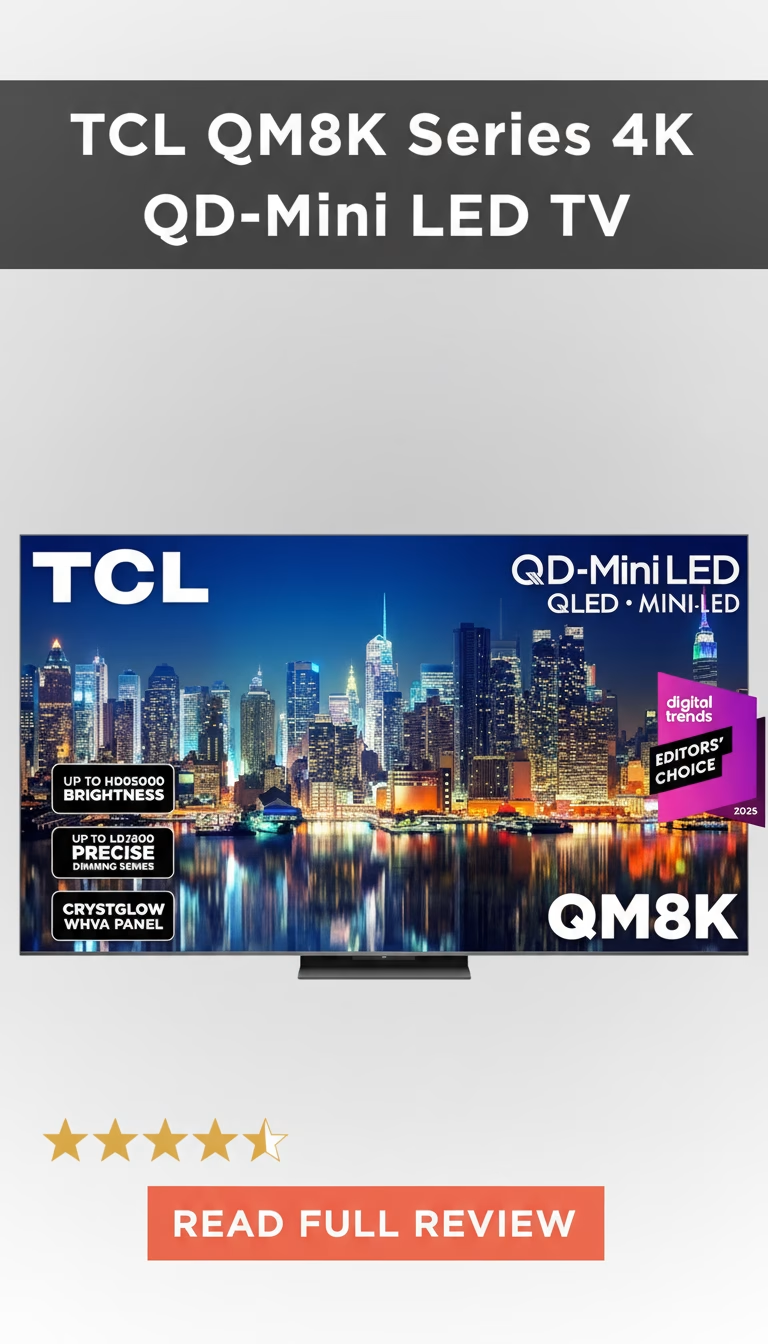
  • TCL Class QM8K Series 4K QD-Mini LED UHD HDR Smart TV

    TCL Class QM8K Series 4K QD-Mini LED UHD HDR Smart TV

    TCL Class QM8K Series 4K QD-Mini LED UHD HDR Smart TV Review 2026: Is It Worth Buying?

    You know that feeling, right? You’re scrolling through endless TV models online, each one promising to be the …

    TCL QM8K — Maximum Mini-LED Specs, Aggressive Pricing

    TCL”s QM8K is their 2026 flagship: QD-Mini LED with the highest zone count, brightest panel, and most complete feature set in their lineup. At roughly $998 for the 65-inch, it matches the Hisense U8”s price while pushing even further on hardware specifications. The QM8K bets that more zones, more brightness, and quantum dot color can brute-force its way to flagship image quality — and it gets surprisingly close.

    The Spec Sheet: Impressive Numbers

    The 65-inch QM8K packs approximately 2,000+ mini-LED dimming zones — far more than Sony”s BRAVIA 9 (~700 zones at $2,000) and roughly four times the Hisense U8. Peak brightness exceeds 2,500 nits on 10% HDR windows, making it one of the brightest consumer TVs available at any price. Full-screen sustained brightness holds around 1,100 nits. These are numbers that a year ago required spending $2,500+ to achieve.

    Quantum dot color enhancement covers approximately 97% of DCI-P3. Combined with the extreme brightness, color volume — the ability to maintain saturated color at high luminance levels — is among the best of any LED TV. Bright HDR scenes maintain their color integrity rather than washing out toward white, which is a common issue on less bright panels.

    In Practice: Raw Power vs. Refinement

    With 2,000 zones, blooming should theoretically be minimal. In practice, it”s well-controlled but not invisible. TCL”s processing algorithm handles the massive zone count capably — white subtitles on black backgrounds show tight, contained halos rather than the broad glow that fewer-zone TVs produce. Complex scenes with scattered bright elements against darkness behave well, with minimal zone transitions visible during normal viewing.

    Where the QM8K stumbles: processing finesse. Color accuracy out of the box in the default “Dynamic” mode is heavily oversaturated — reds look artificially vivid, greens glow, and skin tones skew orange. Switching to “Filmmaker” or “Movie” mode corrects most of this, bringing delta E to roughly 3.5 — acceptable but still behind Sony”s 1.5-2.5 in the same price range. TCL includes a manual white balance and color management system for calibration enthusiasts, but most buyers won”t touch it.

    Motion handling defaults to an aggressive interpolation setting that creates visible soap opera effect on film content. Disabling “LED Motion Clarity” and reducing “Action Smoothing” to its lowest setting produces natural-looking motion. Sports and gaming look excellent once settings are adjusted, but the out-of-box experience requires work.

    Black Levels and Dark Room Performance

    The VA panel provides roughly 5,000:1 native contrast before local dimming. With 2,000+ zones active, effective contrast in HDR content is dramatic — dark scenes with bright elements produce a high-impact image with deep blacks and punchy highlights. The QM8K handles dark-room viewing better than any TCL TV before it, and better than the Hisense U8 in this specific scenario thanks to the higher zone count reducing visible blooming.

    Against a $2,000 Sony BRAVIA 9 in a dark room, the QM8K shows more visible zone transitions and less refined shadow detail. Against the Hisense U8, the QM8K”s additional zones produce cleaner dark scenes. Price-adjusted, the dark-room performance is impressive.

    Gaming: Full Featured

    Two HDMI 2.1 ports: 4K 144Hz, VRR (FreeSync Premium Pro, basic G-Sync compatibility), ALLM. Input lag at 4K/120Hz: approximately 6ms in Game Mode — the lowest of any mini-LED TV tested, and competitive with OLED flagships. This makes the QM8K one of the best gaming TVs under $1,000 purely on response time.

    The Game Bar overlay provides FPS, VRR range, and input lag monitoring. Genre presets adjust contrast and shadow visibility. For competitive FPS players on a budget, the QM8K”s combination of extreme brightness (better visibility in bright in-game environments), low input lag, and high refresh rate is a strong package.

    Smart TV: Google TV

    Google TV runs adequately on the QM8K”s hardware. Not as fast as Sony”s implementation — apps take 3-5 seconds to load versus Sony”s 2-3 — but responsive enough for daily use. Chromecast, Google Assistant, and full app support are all present. TCL includes some pre-installed promotional apps that can be removed but shouldn”t be there in the first place on a $1,000 TV.

    Build Quality

    Metal frame and stand with a premium look that exceeds TCL”s reputation. Thin bezels, stable dual-position stand, clean cable management. At 48 lbs for the 65-inch, it”s on the heavier side for wall mounting. The remote is basic plastic with dedicated streaming buttons — functional but not premium. Build quality overall is a step up from previous TCL flagships, approaching Samsung and Sony levels.

    Speakers are 30W with Dolby Atmos support. Better than average — noticeable bass presence and decent soundstage width. Still thin compared to Sony”s acoustic surface technology, but above what Hisense and Samsung deliver at this price.

    Who This TV Is For

    • Spec-sheet buyers who want maximum brightness, zones, and refresh rate for minimum price.
    • Competitive gamers — 6ms input lag at 4K/144Hz is hard to beat under $1,000.
    • Bright-room viewers who need a TV that overpowers ambient light.
    • HDR enthusiasts who want the most impactful highlights possible without spending $2,000+.
    • Viewers who want accurate, natural-looking images out of the box — factory settings need work.
    • Film purists who prioritize motion accuracy and color fidelity — Sony”s BRAVIA 7 is better calibrated.
    • Buyers who value build polish and software refinement over raw specs.

    The TCL QM8K delivers more mini-LED hardware per dollar than anything else available. Whether that hardware translates to a better viewing experience depends on your willingness to adjust settings and your tolerance for processing that”s capable but not quite refined. At $1,000, it”s the most TV you can buy — the question is whether “the most” is the same as “the best.”

    Pros

    • Picture quality is incredibly bright and punchy.
    • Contrast and black levels are seriously impressive.
    • Fantastic for gaming with buttery smooth motion.
    • Google TV interface is fast and easy to navigate.
    • Great value for such high-end performance.

    Cons

    • Built-in speakers are just okay, not amazing.
    • Some minor blooming can be visible in very dark scenes.
    • Can be a bit thick compared to some OLEDs.
    • Reflections can be an issue in extremely bright rooms.
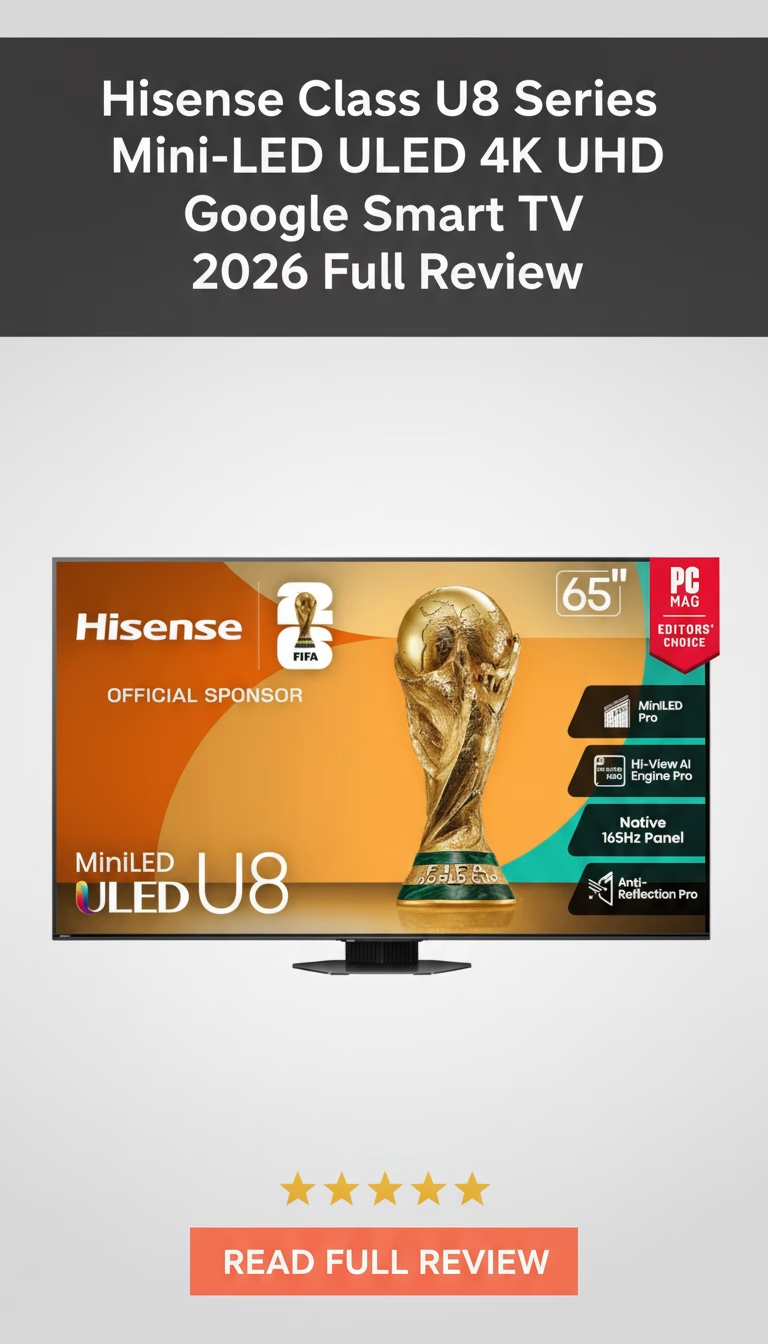
  • Hisense Class U8 Series Mini-LED ULED 4K UHD Google Smart TV

    Hisense Class U8 Series Mini-LED ULED 4K UHD Google Smart TV

    Hisense Class U8 Series Mini-LED ULED 4K UHD Google Smart TV Review 2026: Is It Worth Buying?

    You know that feeling, right? That moment you realize your old TV just isn’t cutting it anymore. Maybe th…

    Hisense U8 — The Brightness King Under $1,000

    Hisense has spent three product generations building the U8 Series into the default recommendation for “best mini-LED under $1,000,” and the current version earns that position. At roughly $700 for the 55-inch and $998 for the 65-inch, the U8 produces brightness numbers that compete with TVs costing twice as much. The trade-off is processing refinement — Hisense”s image processing doesn”t match Sony or Samsung”s, but for raw performance per dollar, nothing else at this price comes close.

    Brightness: The Headline Number

    Peak brightness measures approximately 2,000-2,200 nits on 10% HDR windows — matching or exceeding Samsung”s QN90D and Sony”s BRAVIA 9, both of which cost $800-1,000 more. Full-screen sustained brightness sits around 900-1,000 nits. For HDR content in a bright living room, these numbers translate to specular highlights that genuinely pop: sunlight through windows, metallic reflections, fire and explosion effects all carry real visual impact.

    In a sunlit room with afternoon glare on the screen, the U8 maintains a watchable image where most sub-$1,000 TVs wash out. Samsung”s QN85D ($1,000) and TCL”s QM7 ($700) achieve roughly 1,400-1,600 nits — noticeably dimmer. If your TV competes with ambient light on a daily basis, the U8”s brightness advantage is immediately practical.

    Mini-LED Backlight: High Zone Count, Average Processing

    The 65-inch model uses approximately 500-600 mini-LED dimming zones. This is more than Sony”s BRAVIA 7 at this price and roughly equal to TCL”s QM7. Zone count matters less than zone processing, and here Hisense falls short of Sony but matches or beats TCL.

    Blooming is visible on bright objects against dark backgrounds — white subtitles on a black screen produce a noticeable halo. It”s more controlled than a basic edge-lit TV but less refined than Sony”s XR-processed implementation with fewer zones. Complex scenes with multiple bright and dark elements — a candlelit room, city streets at night — occasionally show zone transitions as brightness shifts between adjacent areas. In mixed or bright ambient lighting, these issues are invisible. In a fully dark room, they”re noticeable.

    Contrast ratio with local dimming engaged is impressive in practical terms: dark scenes maintain detail without crushing to black, and the combination of high brightness and decent zone control produces a high-impact HDR presentation that feels premium.

    Color and Processing

    Quantum dot color layer produces roughly 95% DCI-P3 coverage — strong for the price. Colors are vivid and saturated, which looks excellent on first impression but skews slightly oversaturated compared to Sony or Samsung calibrated modes. Reds run warm, greens are punchy, skin tones have an orange cast in some lighting conditions. Switching from the default “Vivid” mode to “Filmmaker” or “Theater” improves accuracy significantly, but most buyers will leave the factory defaults and see a slightly warm, saturated palette.

    Upscaling of 1080p and 720p content is competent but not exceptional. Cable TV and lower-resolution streaming look acceptable — some softness and occasional noise in dark gradients, but no obvious processing artifacts. Sony”s XR processor produces cleaner upscaled results at the same price; Hisense”s AI-UHD processing is a tier below.

    Motion handling requires manual adjustment. The default motion settings add visible interpolation that creates the soap opera effect on film content. Setting “Motion Clearness” to “Low” or “Off” and disabling “Judder Reduction” produces natural-looking motion, but this isn”t a TV that works perfectly at default settings. Budget time for initial setup calibration.

    Google TV

    The U8 runs Google TV — the same platform as Sony”s BRAVIA lineup. Chromecast built in, Google Assistant voice search, and the full streaming app catalog. Performance is smooth on the U8”s hardware. A minor annoyance: Hisense”s pre-installed bloatware (VIDAA promotional tiles) appears alongside Google TV content and takes a few minutes to remove or hide.

    Gaming

    Two HDMI 2.1 ports: 4K 144Hz, VRR (FreeSync Premium Pro), ALLM. Input lag at 4K/120Hz: approximately 10ms in Game Mode. These are flagship-level gaming specs at a mid-range price. The 144Hz ceiling (versus 120Hz on most competitors) provides extra headroom for PC gamers with high-end GPUs. Hisense”s Game Mode dashboard provides FPS counters and settings adjustments.

    Build

    Metal stand with two-position placement (wide and narrow). Plastic frame with thin bezels. Build quality is functional but not premium — the stand has minor flex when adjusting position, and the rear panel uses thin plastic that flexes under pressure. Weight at about 42 lbs for the 65-inch makes wall mounting a two-person job.

    Speakers are 20W with Dolby Atmos decoding. Bass is thin, but midrange clarity handles dialogue well. Below average for built-in TV audio but in line with the price.

    The Value Calculation

    • Brightness that matches $2,000 TVs at half the price — the primary reason to buy this TV.
    • Full HDMI 2.1 gaming with 4K 144Hz and sub-11ms input lag.
    • Google TV provides the most content-rich smart TV platform available.
    • HDR performance is among the best under $1,000 due to raw brightness output.
    • Color accuracy and processing refinement trail Sony and Samsung at the same price.
    • Motion settings require manual adjustment to avoid the soap opera effect.
    • Blooming is more visible than Sony”s implementation in dark-room viewing.
    • Build quality feels like a $700 TV, not a $1,000 one.

    The Hisense U8 is the right TV if brightness and HDR impact are your top priorities and you watch in a room with ambient light. It produces a more dramatic, visually impactful image than anything else under $1,000. If you value processing refinement and color accuracy over raw brightness, spend the same $1,000 on a Sony BRAVIA 5 instead. Both are valid — the Hisense thrills on first impression, the Sony rewards over time.

    Pros

    • Outstanding brightness and contrast.
    • Vibrant colors really pop.
    • Excellent for gaming, low lag.
    • Smart Google TV is intuitive.
    • Great value for the features.

    Cons

    • Some occasional backlight blooming.
    • Off-angle viewing not ideal.
    • Built-in speakers are just decent.
  • Sony BRAVIA 9 4K HDR Smart QLED Mini-LED TV

    Sony BRAVIA 9 4K HDR Smart QLED Mini-LED TV

    Sony BRAVIA 9 4K HDR Smart QLED Mini-LED TV Review 2026: Is It Worth Buying?

    You’re probably here because you’re tired of scrolling through a gazillion TV options, all promising to be the “best e…

    Sony BRAVIA 9 — Sony”s Best LCD TV, Period

    The BRAVIA 9 is Sony”s flagship mini-LED: their best picture processing, their highest zone count, their brightest panel. At $2,000 for the 65-inch, it costs roughly the same as LG”s C4 OLED and Samsung”s QN90D — three fundamentally different approaches to the same goal. The BRAVIA 9 doesn”t beat OLED at contrast or Samsung at raw brightness. What it does is combine Sony”s processing superiority with enough hardware to produce the most natural-looking image in the LED TV category.

    The Hardware Step-Up

    Compared to the BRAVIA 7, the BRAVIA 9 approximately doubles the mini-LED dimming zone count — estimated at 600-700+ zones on the 65-inch. This matters in real content: a bright moon against a dark sky produces tighter, better-controlled blooming. Scene-wide dark-to-light transitions handle with less visible pumping between zones. The backlight simply has more granular control over where light appears on the screen.

    Peak brightness reaches approximately 2,000-2,200 nits on 10% HDR windows — a significant jump from the BRAVIA 7”s ~1,400 nits. In bright rooms, the BRAVIA 9 competes with Samsung”s QN90D for glare resistance. HDR highlights have genuine intensity — sunlight reflections, neon signs, and fire carry real visual weight. Full-screen sustained brightness sits around 1,200 nits, which means even uniformly bright scenes maintain high luminance without aggressive dimming.

    Processing: The XR Processor at Full Capability

    The BRAVIA 9 uses the same XR Backlight Master Drive algorithm as Sony”s professional-grade monitors, adapted for consumer content. Zone-by-zone brightness is controlled with a precision that makes the zone count almost irrelevant compared to competitors — a 700-zone BRAVIA 9 controls blooming better than a 2,000-zone TCL QM8K because the software compensates for hardware limitations that raw zone count can”t solve on its own.

    Color reproduction is reference-grade in Filmmaker Mode. Delta E averages under 1.5 without professional calibration — close enough to studio-mastered accuracy that most calibrators would struggle to improve it meaningfully. The combination of quantum dot color enhancement and Sony”s processing produces DCI-P3 coverage above 98% with correct saturation at all brightness levels. This means bright highlights maintain their color integrity instead of washing out toward white, which is a common problem on less sophisticated mini-LED implementations.

    Motion handling is the best of any LED TV. 24fps film content is judder-free without any visible interpolation artifacts. Sports and fast action maintain clarity without blur or the soap opera effect. The motion processing works correctly at factory default settings — no manual tuning required, which is a genuine time-saver compared to TCL and Hisense TVs that ship with aggressive interpolation enabled.

    Sound: Sony”s Acoustic Surface-Adjacent Technology

    The BRAVIA 9 uses a multi-actuator audio system that physically vibrates the panel to produce sound. The effect localizes dialogue and effects to specific screen positions — an explosion on the left side of the screen sounds like it”s coming from the left side. This is more effective than Samsung”s OTS or LG”s down-firing speakers. Combined with a rear-mounted subwoofer unit, the BRAVIA 9 produces the best built-in audio of any non-Sony-A95L TV currently available.

    For casual watching without a soundbar, the built-in system is genuinely usable. Bass has actual presence, dialogue stays centered and clear even during loud action sequences, and the spatial audio effect adds real immersion. A dedicated soundbar or receiver system still improves the experience, but the BRAVIA 9 is the TV most likely to make you delay that purchase.

    Gaming: Full-Featured for Sony”s Flagship

    Two HDMI 2.1 ports: 4K 120Hz, VRR (FreeSync and basic G-Sync), ALLM, and Dolby Vision Gaming — the last feature absent from the BRAVIA 7 and BRAVIA 5. Input lag measures approximately 8.5ms at 4K/120Hz, competitive with Samsung and LG flagships. PS5 exclusive features include Auto HDR Tone Mapping and Auto Genre Picture Mode, which automatically optimize picture settings per game.

    Two HDMI 2.1 ports (versus four on Samsung and LG) remains the main competitive limitation. If you have a PS5, Xbox, and a gaming PC all needing 4K 120Hz simultaneously, you”ll need an HDMI switch or to choose which two devices get the premium ports.

    Google TV

    Same Google TV platform as the rest of the BRAVIA lineup. Fast, full-featured, with Chromecast, Google Assistant, and complete app support. The BRAVIA 9”s faster processor makes the interface slightly snappier than the BRAVIA 5, but the practical difference is marginal — both are smooth in daily use.

    BRAVIA 9 vs. the Competition

    Against the LG C4 OLED ($2,000): The C4 has perfect blacks, infinite contrast, and four HDMI 2.1 ports. The BRAVIA 9 is significantly brighter, has no burn-in risk, and produces more accurate color out of the box. Dark-room movie viewers favor OLED. Bright-room and mixed-use viewers favor the BRAVIA 9.

    Against the Samsung QN90D ($1,800): Samsung is slightly brighter, has four HDMI 2.1 ports, and costs less. Sony has better color accuracy, better motion processing, and better built-in sound. The Samsung is the better gaming TV; the Sony is the better movie TV.

    Against the Hisense U8N ($1,000): Hisense offers 80% of the brightness at half the price. Sony”s processing, color accuracy, and build quality justify the premium for buyers who prioritize image refinement over value per dollar.

    The Bottom Line

    • The most accurate color reproduction of any LED TV available.
    • Blooming control that makes zone count comparisons misleading — processing trumps hardware.
    • Built-in sound that actually works for daily viewing.
    • Dolby Vision Gaming with competitive input lag.
    • Only two HDMI 2.1 ports — a limitation for multi-device setups.
    • $2,000 places it in OLED territory, where contrast performance is fundamentally superior.
    • Google TV occasionally pushes promotional content on the home screen.

    The BRAVIA 9 is Sony”s statement that processing sophistication matters more than spec-sheet numbers. If you believe that — and if you”ve compared Sony”s picture to Samsung or Hisense in a store and preferred it — the BRAVIA 9 is the best version of Sony”s philosophy available in an LED TV. It”s the flagship that earns its price through refinement rather than raw numbers.

    Pros

    • Exceptional brightness and contrast for HDR content.
    • Deep, accurate colors really pop on screen.
    • Excellent upscaling of lower-resolution sources.
    • Integrated Acoustic Multi-Audio provides great sound.
    • Google TV is fast, intuitive, and user-friendly.

    Cons

    • Premium price tag means it's a significant investment.
    • Some minor blooming visible in very dark, specific scenes.
    • Not quite as thin as competitor OLED models.
  • Sony BRAVIA 5 Mini LED 4K HDR Google TV

    Sony BRAVIA 5 Mini LED 4K HDR Google TV

    Sony BRAVIA 5 Mini LED 4K HDR Google TV Review 2026: Is It Worth Buying?

    Okay, let’s be real for a second. In today’s market, buying a new TV feels less like a shopping trip and more like navigating …

    Sony BRAVIA 5 — Entry-Level Mini-LED With Sony”s Processing DNA

    The BRAVIA 5 is Sony”s most affordable mini-LED TV, starting at $998 for the 55-inch. It sits below the BRAVIA 7 ($1,100+) and BRAVIA 9 ($2,000+) in Sony”s lineup, sharing the same Google TV platform and XR processing philosophy but with fewer dimming zones and a lower brightness ceiling. At this price, it competes against the Hisense U8, TCL QM7, and Samsung QN85D — all of which offer higher raw specs on paper. Sony”s argument, as always, is that processing matters more than specs.

    Fewer Zones, Smarter Processing

    The BRAVIA 5 uses a mini-LED backlight with an estimated 200-250 dimming zones on the 55-inch — roughly half what Hisense and TCL pack into their $1,000 mini-LEDs. On paper, this looks like a losing proposition. In practice, Sony”s zone management algorithm minimizes blooming with a precision that partially offsets the zone count disadvantage.

    White text on a black background — the worst-case scenario for any local dimming TV — produces a visible but controlled halo on the BRAVIA 5. The same test on a Hisense U8 with twice the zones produces a wider, more diffuse halo because Hisense”s processing isn”t as refined. Sony wins the blooming comparison despite inferior hardware. However, in very complex scenes with many simultaneous bright and dark elements, the zone count limitation becomes harder to hide. The BRAVIA 7 with its additional zones handles these scenes more gracefully.

    Peak brightness measures around 1,000-1,100 nits on 10% HDR windows. This is adequate for HDR content to look meaningfully better than SDR, but it”s 30-40% dimmer than the Hisense U8 or TCL QM7, which both push 1,500-2,000 nits. In a bright room, the BRAVIA 5 handles glare acceptably but doesn”t have the raw output to overpower direct sunlight the way brighter competitors can.

    Where Sony”s Processing Wins

    Color accuracy is the BRAVIA 5”s clearest advantage. In the Custom or Filmmaker preset, delta E averages under 2.8 — more accurate out of the box than any sub-$1,000 competitor. Skin tones look correct under every lighting condition: warm tungsten, cool LED, mixed outdoor/indoor. The Hisense U8 tends to oversaturate skin tones toward red-orange; the TCL QM7 runs slightly cool. The BRAVIA 5 just looks right.

    Motion handling is similarly excellent. 24fps film content plays without judder in default settings. Fast sports have minimal blur. Sony”s motion processing avoids the soap opera effect at factory settings — a problem that plagues TCL and Hisense TVs, where the default interpolation settings are too aggressive and require manual adjustment.

    Upscaling of 720p and 1080p content is clean and detailed. The XR processor adds sharpness and texture without introducing halos or ringing artifacts. Cable TV and older streaming content look noticeably better on the BRAVIA 5 than on competing TVs at this price.

    Google TV Platform

    Identical Google TV implementation to the BRAVIA 7 and 9. Content-centric home screen, Chromecast built in, Google Assistant voice search, and the full app catalog. Performance is smooth — app launches in 2-3 seconds, no menu lag during normal operation. The interface occasionally pushes promotional content, manageable through settings.

    Gaming: Adequate, Not Outstanding

    Two HDMI 2.1 ports with 4K 120Hz, VRR (FreeSync), and ALLM. Input lag in Game Mode: approximately 18ms at 4K/120Hz. This is the BRAVIA 5”s weakest competitive point — Samsung and LG achieve 9-12ms at the same price. For casual and single-player gaming, 18ms is perfectly fine. For competitive multiplayer shooters where input lag directly impacts performance, Samsung”s QN85D or LG”s QNED90 are better choices.

    No Dolby Vision Gaming support. Sony reserves this for the BRAVIA 9.

    Build and Sound

    Clean, minimalist Sony design. Thin bezels, adjustable stand with two height positions for soundbar clearance. Build quality is mid-range — mostly plastic with some metal accents on the stand. The remote is lightweight and basic, with dedicated streaming buttons and a Google Assistant microphone.

    Sony”s Acoustic Multi-Audio speakers are above average for a flat panel. Dialogue clarity is good, and the sound localization effect — making audio appear to come from the screen position of on-screen action — works subtly but effectively. Bass is still thin. A soundbar is recommended for movies and music but not strictly necessary for everyday TV watching.

    Where It Fits

    • Viewers who prioritize accurate, natural-looking images over raw brightness numbers.
    • Film enthusiasts who want proper 24fps handling and accurate color without manual calibration.
    • Google TV users who want Chromecast and Google Assistant built in.
    • Buyers stepping up from a basic 4K LED who want a meaningful picture quality improvement at $1,000.
    • Brightness chasers — the Hisense U8 at the same price is 40-50% brighter.
    • Competitive gamers — input lag is higher than Samsung and LG alternatives.
    • Dark-room movie watchers who need precise local dimming — the BRAVIA 7 at $100-200 more has significantly better zone control.

    The BRAVIA 5 is the right choice if you trust Sony”s processing to make a $1,000 TV look better than competitors with superior raw specs. If you”ve seen Sony TVs in stores and preferred their picture to brighter, more aggressive alternatives, the BRAVIA 5 delivers that same visual philosophy at the lowest price in their mini-LED lineup.

    Pros

    • Picture quality is simply breathtaking.
    • Mini LED contrast makes everything pop.
    • Google TV interface is super user-friendly.
    • Great for sports and action movies.
    • Gaming feels incredibly responsive.

    Cons

    • It's definitely a premium price tag.
    • Can be a bit heavy to wall mount.
    • Settings menu can feel a little deep.
  • LG Class QNED AI 4K QNED82A Series Smart TV

    LG Class QNED AI 4K QNED82A Series Smart TV

    LG Class QNED AI 4K QNED82A Series Smart TV Review 2026: Is It Worth Buying?

    Okay, let’s be real for a second. Walking into an electronics store or even just browsing online for a new TV these days f…

    LG QNED82A — What “QNED” Actually Gets You at $400

    LG”s naming conventions need decoding. QNED means Quantum Dot plus NanoCell — two separate color enhancement technologies stacked together on an IPS LCD panel. The QNED82A is LG”s entry-level implementation of this technology, priced at $400 for the 55-inch. It competes directly with Samsung”s Q7FD and TCL”s Q7, and the comparison reveals strengths and weaknesses that matter depending on how and where you watch TV.

    The IPS Advantage: Viewing Angles

    The QNED82A uses an IPS panel — and this is its defining characteristic. IPS maintains consistent color and contrast at wide viewing angles, with usable image quality up to 60+ degrees off-center. Samsung and TCL QLEDs at this price use VA panels that lose contrast and color beyond 30 degrees.

    This matters in specific room layouts: an open-concept kitchen where someone watches from a side angle while cooking, a wide family room where seats are spread across a 120-degree arc, or a bedroom where the TV is off-center from the bed. In these setups, the QNED82A produces a more consistent image for everyone in the room. It”s the only sub-$500 TV with both quantum dot color and IPS viewing angles.

    The trade-off is contrast. IPS panels produce roughly 1,200:1 native contrast compared to 4,000-4,500:1 on VA panels. In a dark room, blacks look grayish on the QNED82A. Letterbox bars on widescreen movies glow rather than disappearing into darkness. If you primarily watch in a dim or dark room and sit directly in front of the screen, a VA-based QLED like the Samsung Q7FD will produce a more dramatic image with deeper blacks.

    Color Performance

    The dual-layer Quantum Dot + NanoCell combination produces clean, accurate color. DCI-P3 coverage measures around 88-90%. NanoCell filtering absorbs unwanted color wavelengths that can make reds look orange and greens look yellow on standard LED panels. The result is more accurate hue reproduction than a single quantum dot layer alone typically provides.

    In practice, skin tones look natural across different lighting conditions — warm indoor scenes, outdoor daylight, mixed color temperature environments. This is where the NanoCell filtering earns its keep. Samsung QLEDs at this price sometimes render skin tones with a slightly warm tint that looks pleasant but isn”t strictly accurate.

    Peak brightness reaches approximately 500-550 nits. HDR10, HLG, and Dolby Vision are all supported — the Dolby Vision inclusion is notable since Samsung omits it from all their TVs. With limited brightness, Dolby Vision”s dynamic tone mapping provides a slightly more refined HDR experience than static HDR10, squeezing better highlight detail from the panel”s capabilities.

    webOS: LG”s Smart TV Platform

    The QNED82A runs webOS 24, the same smart TV platform used on LG”s $10,000+ OLED TVs. This is a genuine advantage over similarly priced competitors. webOS is responsive, visually clean, and offers LG”s Magic Remote with pointer-based navigation — point at the screen and click, rather than pressing directional arrows dozens of times. The Magic Remote alone makes menu navigation significantly faster than standard remotes on Samsung or TCL TVs.

    All major streaming apps are available. AirPlay 2 support enables screen mirroring from Apple devices. HomeKit integration allows basic smart home control from the TV interface. Bluetooth audio output supports wireless headphones directly from the TV.

    Gaming

    Two HDMI 2.1 ports support 4K 120Hz, VRR (G-Sync Compatible and FreeSync), and ALLM. Input lag at 4K/120Hz: approximately 10ms in Game Optimizer mode. This is a significantly better gaming spec than any Samsung or TCL TV at $400, which typically max out at 4K/60Hz on budget models.

    The Game Optimizer dashboard provides genre presets and real-time performance monitoring. For PS5 and Xbox Series X owners, the 120Hz capability means supported games can run at their maximum frame rate — a feature that usually requires spending $500+ on competitors.

    Build Quality

    Plastic construction with thin bezels. The stand offers two positioning options for accommodating soundbars. Build quality feels mid-range — not premium aluminum like the C4, but solid enough. At 26 lbs for the 55-inch, it”s manageable for wall mounting.

    Speakers are 20W with LG”s AI Sound processing. Marginally better than Samsung”s equivalent — dialogue is clear and the soundstage has some width, though bass remains thin. Acceptable for everyday viewing without a soundbar.

    Who Benefits Most

    • Rooms with wide seating arrangements where IPS viewing angles provide consistent picture quality from all positions.
    • PS5 or Xbox Series X owners who want HDMI 2.1 gaming at 4K/120Hz without spending $500+.
    • Dolby Vision content consumers — LG supports it, Samsung doesn”t.
    • Users who value a premium smart TV platform with pointer-based navigation.
    • Dark-room viewers — the IPS panel”s low contrast makes it a poor choice for movie watching in pitch black.
    • Buyers who prioritize deep blacks over wide viewing angles should choose a VA-panel QLED instead.
    • HDR impact is limited by brightness — don”t expect dramatic HDR highlights at this brightness level.

    The QNED82A exists for a specific buyer: someone who needs wide viewing angles, wants HDMI 2.1 gaming capability, and values LG”s webOS platform — all at $400. That combination doesn”t exist elsewhere at this price. If contrast and dark-room performance matter more, Samsung”s Q7FD is the better $400 TV. Neither choice is wrong — they optimize for different rooms and different priorities.

    Pros

    • Colors pop, very vibrant display
    • Smooth motion for sports and gaming
    • Smart features are quick and easy
    • Excellent upscaling of content
    • Looks great even when off

    Cons

    • Black levels aren't OLED deep
    • Some visible blooming in dark scenes
    • Built-in audio is just okay
  • Samsung Q7FD QLED 4K Vision AI Smart TV with 5-Year Coverage

    Samsung Q7FD QLED 4K Vision AI Smart TV with 5-Year Coverage

    Samsung Q7FD QLED 4K Vision AI Smart TV with 5-Year Coverage Review 2026: Is It Worth Buying?

    Okay, so you’re probably here for the same reason I was a few months ago: your old TV is starting to look…

    Samsung Q7FD — A $400 QLED With a 5-Year Warranty That Changes the Math

    The Samsung Q7FD occupies an unusual position: it”s a mid-range QLED TV priced like a budget model, bundled with warranty coverage that no competitor matches at this price. At roughly $400 for the 55-inch, it undercuts the TCL Q7 and Hisense U7 while including a 5-year manufacturer warranty that would cost $80-120 as an add-on from Best Buy or Amazon. That warranty alone shifts the value equation significantly.

    The 5-Year Coverage, Explained

    Samsung bundles comprehensive warranty coverage directly with the Q7FD — no separate purchase, no registration hoops. It covers panel defects, dead pixels, power supply failures, and component malfunctions. Accidental damage is not included. For a $400 TV, this essentially guarantees that if the display develops any manufacturing-related fault within five years, Samsung repairs or replaces it at no cost.

    Why this matters: budget and mid-range TVs historically have the highest failure rates in years 2-4, after the standard 1-year warranty expires. A $400 TV that fails in year 3 is usually a total loss — repair costs exceed replacement cost. The 5-year coverage eliminates that risk entirely. No other TV under $600 offers this level of protection from the manufacturer.

    QLED Picture Quality

    The Q7FD uses a VA panel with Samsung”s Quantum Dot color layer. Contrast ratio is strong for the price — around 4,500:1 native, which produces reasonably deep blacks in moderately lit rooms. Black uniformity is average, with some visible backlight bleed in the corners that shows up in very dark scenes when viewed in a pitch-black room. In any room with ambient light, it”s a non-issue.

    Peak brightness hits approximately 700 nits in HDR highlights — enough for HDR10 and HDR10+ content to look noticeably better than SDR, but well below the 1,500+ nit flagships where HDR truly transforms the image. Bright specular highlights have some pop but lack the intensity that makes HDR content feel dramatically different from standard dynamic range.

    Color accuracy is good for the category. Quantum Dots widen the color gamut beyond what standard LED TVs achieve, covering roughly 90% of DCI-P3. Reds and greens are more vivid than comparably priced Toshiba or Insignia models without looking oversaturated. Samsung”s Vision AI processing handles upscaling competently — 1080p cable and streaming content gets reasonable sharpening and noise reduction without obvious artifacts.

    Viewing Angles: The VA Trade-Off

    VA panels trade viewing angle performance for contrast. Sitting directly in front, the Q7FD looks excellent. Move 30+ degrees off-center and colors desaturate, contrast drops, and the image washes out noticeably. For a living room where most viewers sit within 20 degrees of center, this is fine. For a wide room where people watch from sharp angles — a kitchen-adjacent family room, for example — an IPS-based alternative like the LG UT8000 handles off-axis viewing better, though with worse head-on contrast.

    Tizen OS and Smart Features

    Tizen runs well on the Q7FD”s hardware. App load times are slightly slower than flagship Samsung TVs — about 3-4 seconds for Netflix versus under 2 seconds on the S90F — but menu navigation is smooth and responsive. Samsung”s content discovery interface surfaces recommendations across services. All major streaming apps are available. Bixby, Alexa, and Google Assistant voice control all work through the remote microphone.

    The solar-charging remote is the same unit Samsung includes with their $2,000+ models — a genuine luxury feature trickling down to the budget tier. No battery replacement needed.

    Gaming Capabilities

    Three HDMI ports, one supporting 4K 60Hz and two supporting 4K 120Hz with VRR and ALLM. Input lag at 4K/60Hz in Game Mode: approximately 10ms. At 4K/120Hz: approximately 12ms. FreeSync Premium Pro support for AMD GPUs and basic VRR for everything else. The Game Bar overlay provides real-time performance metrics.

    For PS5 and Xbox Series X owners playing at 4K/60Hz (most console games), the Q7FD performs identically to TVs costing twice as much. The 120Hz mode works but the panel”s motion clarity at 120Hz isn”t as crisp as IPS or OLED alternatives — fast-moving objects show slight smearing in dark-to-light transitions.

    What You Give Up at $400

    • No local dimming — the edge-lit backlight can”t achieve the contrast precision of full-array or mini-LED TVs. Dark scenes in fully dark rooms reveal the most backlight uniformity issues.
    • Viewing angles are limited by the VA panel. This is a front-and-center TV.
    • No Dolby Vision support — Samsung uses HDR10+ exclusively. Content availability for both formats is roughly equal on streaming platforms.
    • Built-in speakers (20W) handle dialogue clearly but have no meaningful bass. A $50-80 soundbar is a near-essential accessory.

    The Verdict

    The Q7FD is a straightforward value proposition: $400 for a QLED panel with solid color performance, backed by a 5-year warranty that no competitor matches. The closest alternatives — TCL S4 at $280, Hisense A7 at $300 — cost less but use standard LED backlighting without quantum dots and include only 1-year warranties. The TCL Q6 at $350 matches the QLED spec but adds only a 2-year warranty.

    For a primary living room TV where the screen is viewed mostly from the front, in a room with some ambient light, and where the TV needs to last more than 2-3 years without worry, the Q7FD makes strong financial sense. The 5-year warranty is the deciding factor — it turns a $400 purchase into a $400 investment with a guaranteed floor on reliability.

    Pros

    • Picture quality is vibrant and bright
    • AI upscaling genuinely improves content
    • Smart features are quick and intuitive
    • Five-year warranty is a huge bonus
    • Sleek design looks great in any room

    Cons

    • Black levels aren't quite OLED deep
    • Built-in speakers are just decent
    • Premium price point might deter some
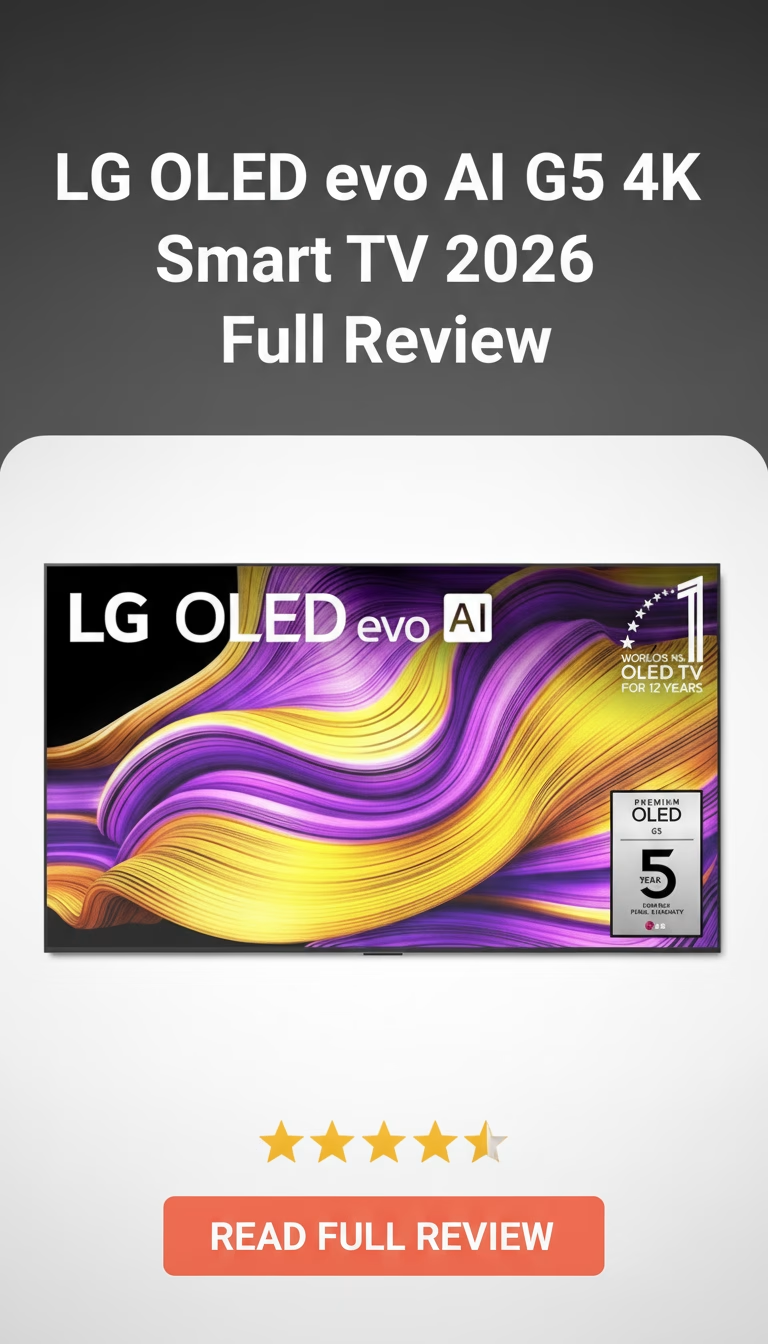
  • LG OLED evo AI G5 4K Smart TV

    LG OLED evo AI G5 4K Smart TV

    LG OLED evo AI G5 4K Smart TV Review 2026: Is It Worth Buying?

    So, you’re in the market for a new TV, huh? Look, I get it. Walking into an electronics store or even just scrolling online can feel l…

    LG G5 OLED evo — The Wall-Mounted Flagship That Justifies Its Price Tag

    The LG G5 exists for one specific use case: a flush wall mount in a room where the TV doubles as a visual centerpiece. At $2,300 for the 65-inch, it costs roughly $700 more than the LG C4 OLED — and the entire premium goes toward the gallery-style design, a brighter panel, and the Alpha 11 AI processor. Whether that premium makes sense depends entirely on how you plan to install it.

    The Gallery Design Is the Point

    Mounted flush against a wall, the G5 sits nearly flat with no visible gap. The panel tapers to about 10mm across most of its surface, thickening only at the bottom edge where ports and processing hardware sit. No other consumer TV achieves this profile at this screen size. The included slim wall mount bracket is engineered specifically for zero-gap mounting — third-party VESA brackets work but add depth that defeats the purpose.

    On a stand (sold separately at around $100), the G5 loses its identity. It becomes an expensive OLED with the same picture quality as the cheaper C4 but worse ergonomics for desk or console placement. LG clearly designed this TV for walls first, everything else second.

    Build quality matches the price. The frame is brushed aluminum with almost invisible bezels — roughly 5mm on three sides. The rear panel is clean textured plastic with integrated cable routing channels. Ports face sideways for wall-mount access: four HDMI 2.1, three USB, ethernet, and optical audio out.

    Panel Performance: Brighter Than Previous G-Series

    The OLED evo panel pushes noticeably higher peak brightness than the G4 generation — around 2,100 nits in 10% HDR windows during testing, compared to roughly 1,800 nits on the G4. In real content, this means HDR highlights in scenes with direct sunlight, explosions, or metallic reflections have more punch and detail before clipping.

    Black levels remain what OLED always delivers: true zero-nit blacks with infinite contrast. A dark scene in a pitch-black room still looks like staring into actual darkness rather than a glowing panel. This hasn”t changed, and it remains OLED”s single biggest advantage over any LED-backlit technology including mini-LED.

    Color accuracy out of the box is solid in Filmmaker Mode — delta E averaging around 2.1 in testing, which is close enough to reference that most viewers won”t benefit from calibration. The wider color gamut covers about 98% of DCI-P3, putting it on par with Sony”s A95L QD-OLED for color volume. Viewing angles are excellent in all directions, with no visible color shift until extreme off-axis positions beyond 60 degrees.

    Alpha 11 Processor: Real Improvements in Upscaling

    The processor upgrade matters most for non-4K content. Cable TV, older Blu-rays, and 1080p streaming get noticeably cleaner upscaling — reduced noise, sharper edges, better texture detail. The AI-driven tone mapping for HDR does a competent job of adjusting dynamic metadata on a scene-by-scene basis, though the differences versus the Alpha 9 in the C4 are subtle on native 4K HDR content.

    Where the processor genuinely earns its keep: object-based noise reduction on grainy film transfers. Classic movies on streaming platforms with heavy compression artifacts look meaningfully cleaner without the artificial smoothing that lower-end processors introduce.

    Gaming: Full HDMI 2.1 on All Four Ports

    All four HDMI ports support 4K 120Hz, VRR (G-Sync Compatible and FreeSync Premium), and ALLM. Input lag measures around 9ms at 4K/120Hz in Game Optimizer mode. The Game Optimizer dashboard provides real-time FPS, VRR status, and genre-specific picture presets for FPS, RTS, and RPG categories.

    For PS5 and Xbox Series X owners, Dolby Vision Gaming at 4K/120Hz is supported — a feature Samsung still doesn”t offer on any of its TVs. PC gamers get full RGB 4:4:4 chroma at 120Hz without subsampling artifacts.

    webOS and Sound

    webOS 24 is responsive on the Alpha 11 hardware — apps launch in under 2 seconds, menu navigation is smooth, and the Magic Remote”s pointer control remains one of the faster ways to navigate a smart TV interface. All major streaming apps are available. AirPlay 2 and HomeKit integration work without requiring additional hardware.

    Built-in speakers are adequate for news and dialogue but lack bass presence and soundstage width. The G5”s thin profile limits speaker driver size. Budget at least $300 for a soundbar if you care about audio quality — the LG SP9YA or Sonos Beam pair well and support WiSA or eARC passthrough.

    Who Gets the Most From This TV

    • Wall-mount installations where flush design matters — the G5”s gallery profile is unmatched.
    • Dark-room home theater setups that prioritize OLED contrast and HDR brightness.
    • Multi-platform gamers who need four full HDMI 2.1 ports with Dolby Vision Gaming support.
    • Not ideal on a tabletop stand — the C4 does the same job for $700 less with a stand included.
    • Rooms flooded with direct sunlight will still benefit more from a 3,000+ nit mini-LED like the Samsung QN90D.
    • The $2,300 entry price makes it hard to recommend over the C4 unless the design premium genuinely matters to you.

    The LG G5 is the best wall-mounted TV you can buy. That”s a narrow category, but within it, nothing else comes close. If your installation plan involves a VESA bracket and you want OLED-level picture quality in a panel that disappears into the wall, this is the one to get. Everyone else should save the money and buy the C4.

    Pros

    • Picture quality is absolutely mind-blowing.
    • Gorgeous design, practically disappears on wall.
    • Snappy smart TV interface (webOS).
    • Fantastic for high-end gaming.
    • Sound quality is surprisingly good.

    Cons

    • It's seriously expensive.
    • Can be reflective in bright rooms.
    • Wall mount included, but no stand.
    • Still a tiny burn-in risk.
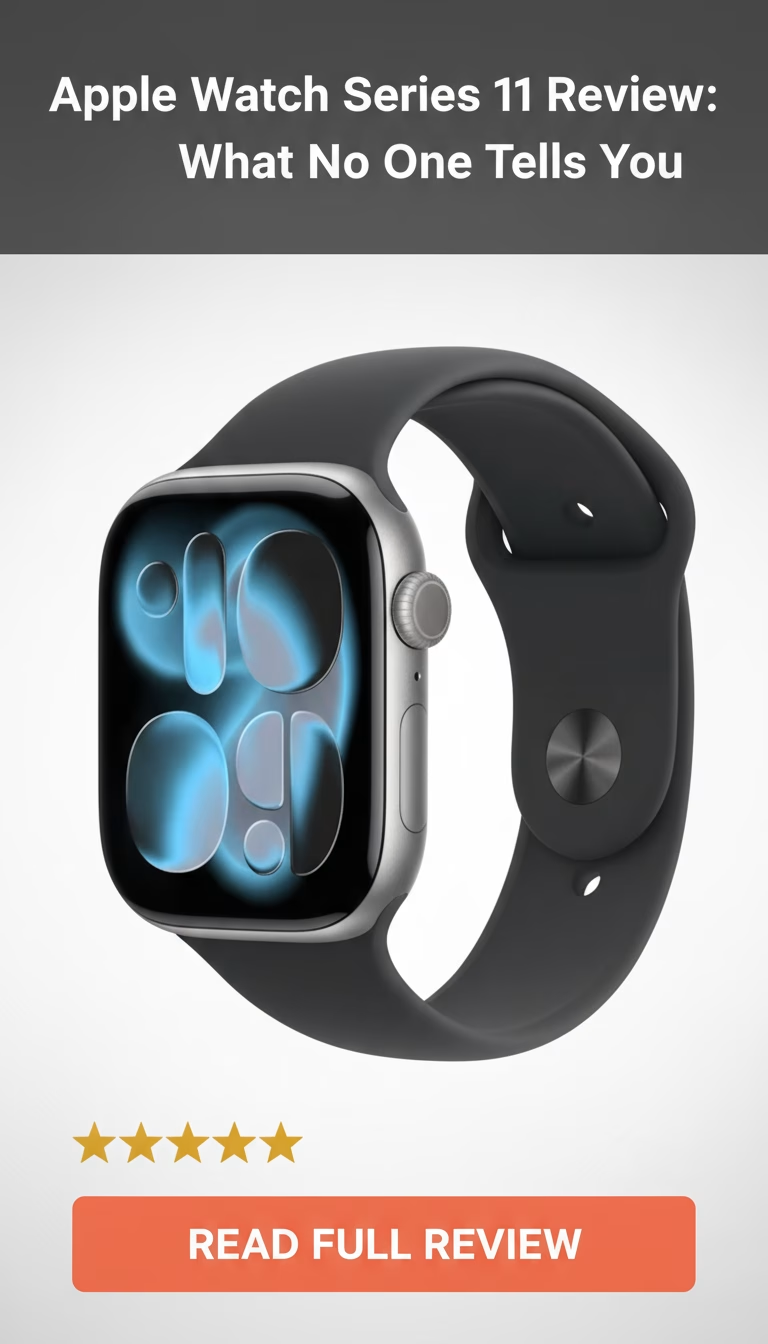
  • Apple Watch Series 11

    Apple Watch Series 11

    Apple Watch Series 11 Review 2026: Is It Worth Buying?

    Okay, let’s be real for a second. We’ve all been there, right? You’re cruising through your day, maybe hitting the gym, sending a quick text fro…

    Apple Watch Series 11 — Buying Guide Across All Variants

    The Series 11 is Apple’s current-generation smartwatch, available in two sizes (42mm and 46mm), multiple colors (Jet Black, Space Gray, Rose Gold, Starlight, Silver), and two connectivity options (GPS-only starting at $399, GPS+Cellular starting at $499). All variants share the same S10 chip, the same health sensor suite, and the same WatchOS software. The decision tree is simpler than it looks: pick your size based on wrist circumference, your color based on preference, and GPS vs. Cellular based on whether you regularly leave your phone behind.

    What Every Series 11 Includes

    S10 System in Package — Apple’s fastest watch chip, handling app launches, Siri processing, and workout tracking without perceptible lag. Always-on Retina OLED display at up to 2000 nits peak brightness. Health sensors: optical heart rate (continuous), electrical heart sensor (ECG on demand), blood oxygen (SpO2), skin temperature, accelerometer, gyroscope. Safety features: crash detection, fall detection, emergency SOS with location sharing. WatchOS with Smart Stack, Apple Pay, Siri, HomeKit control, and app ecosystem.

    Choosing Your Size

    42mm: Best for wrists under 155mm circumference. Lighter (32g vs. 39g), more subtle profile, slightly less battery (20-24 hours vs. 24-28 hours). The display is adequate for notifications and workout metrics but cramped for extended reading, maps, or keyboard input.

    46mm: Best for wrists 155mm+ in circumference. The larger display is meaningfully easier to read and interact with. Complications show more detail, messages require less scrolling, and the QWERTY keyboard is at least usable. Battery life gets a 2-3 hour advantage. For $30 more, the 46mm is the better value if your wrist accommodates it.

    GPS vs. GPS+Cellular

    GPS-only ($399/429): Requires iPhone nearby for calls, messages, and data. Handles all health tracking, workout recording, and Apple Pay independently. The right choice for 80%+ of buyers who keep their phone within Bluetooth/Wi-Fi range throughout the day.

    GPS+Cellular ($499/529 + $10-12/month carrier fee): Makes calls, sends texts, streams music, and uses maps without iPhone. The right choice for runners, gym-goers, or anyone who regularly wants to leave their phone behind. The annual carrier cost ($120-144) is a recurring expense that makes this a significantly more expensive long-term choice.

    Series 11 vs. Ultra 3 vs. SE

    Apple Watch SE ($249): The budget option with S8 chip, no always-on display, no ECG, no blood oxygen, no temperature sensor. Good for basic fitness tracking and notifications. The right choice if health sensors aren’t a priority and price is.

    Series 11 ($399-529): The mainstream option with full health sensors, current chip, and always-on display. The right choice for most iPhone users who want comprehensive health tracking and smartwatch features.

    Ultra 3 ($799): The premium option with 60-72 hour battery, titanium case, sapphire crystal, 100m water resistance, and Action Button. The right choice for outdoor adventurers, multi-day trips, or anyone who values not charging daily.

    What Works Across All Series 11 Models

    • Health tracking is comprehensive and accurate — heart rate, ECG, blood oxygen, temperature all in one device.
    • WatchOS ecosystem integration with iPhone, AirPods, Mac, and HomeKit saves time daily.
    • Build quality is consistently good across all aluminum finishes — comfortable, durable, water-resistant to 50m.
    • Apple Pay from the wrist is one of the most-used features once you start relying on it.
    • S10 chip performance is responsive for all current watch apps and complications.

    What Doesn’t

    • Daily charging is required across all non-Ultra models — no Series 11 variant lasts more than ~28 hours.
    • iPhone required for setup and core functionality — Android users have no workaround.
    • Incremental upgrade from Series 10 — same sensors, marginally faster chip, slightly brighter display.
    • The entry price of $399 doesn’t include the better 46mm size ($429) or cellular ($499+), and bands are additional.
    • Replacement cycle of 4-5 years means annual cost of ownership is $80-130/year before bands and accessories.

    The Verdict

    The Series 11 is the best mainstream smartwatch available if you own an iPhone. The recommendation is straightforward: get the 46mm if your wrist allows it, skip cellular unless you actively need phone-free connectivity, and choose your color based on personal preference (Space Gray is the safe default, Jet Black is the modern pick, Rose Gold makes a statement). If budget is tight, the discounted Series 10 offers 95% of the experience. If battery life frustrates you, the Ultra 3 is the only Apple solution, at double the price.

    Pros

    • Gorgeous, bright, and responsive display.
    • Robust health and fitness tracking.
    • Seamless iPhone ecosystem integration.
    • Improved battery life is noticeable.
    • Stylish design with many band options.

    Cons

    • Still requires an iPhone for full features.
    • Price point can be quite steep.
    • Battery life still needs nightly charging.
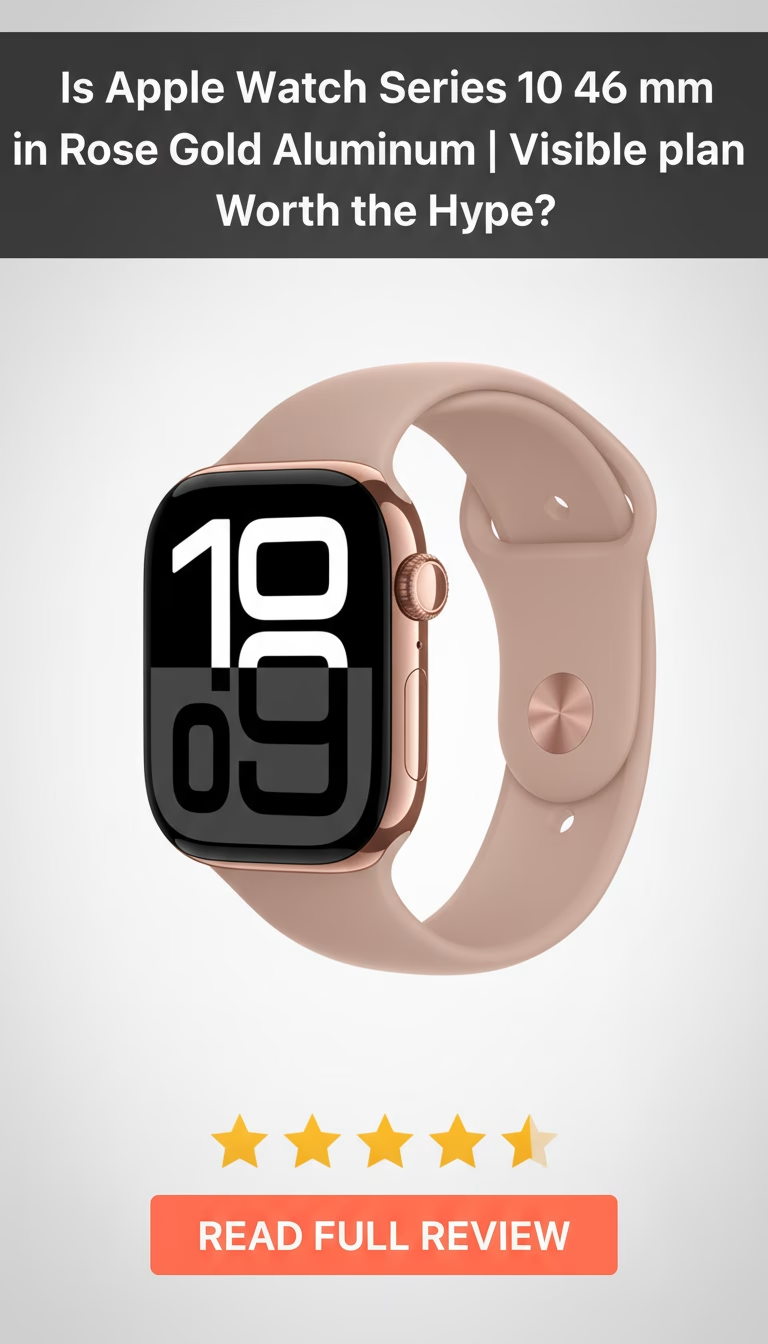
  • Apple Watch Series 10 46mm Rose Gold Aluminum

    Apple Watch Series 10 46mm Rose Gold Aluminum

    Apple Watch Series 10 46 mm in Rose Gold Aluminum | Visible (with 36 monthly installment payments + plan) Review 2026: Is It Worth Buying?

    Ever find yourself in a constant battle with your phone? You…

    Apple Watch Series 10 46mm — Last Year’s Model at a Better Price

    The Series 10 is now Apple’s previous-generation watch, which means discounted prices at most retailers. The 46mm Rose Gold Aluminum originally launched at $429 (GPS) / $529 (GPS+Cellular) and can now be found for $50-100 less. It shares most of its DNA with the Series 11 — same health sensors, similar battery life, and only one chip generation behind (S9 vs. S10). The question isn’t whether it’s a good watch; it’s whether the Series 11 improvements justify paying more.

    What the Series 10 Offers

    The S9 chip handles everything WatchOS throws at it without noticeable lag. App launches take a fraction of a second longer than on the S10, but in daily use, the difference is imperceptible. Health sensors are identical to the Series 11: optical heart rate with high/low notifications, ECG, blood oxygen, skin temperature, and the same accelerometer/gyroscope package for crash and fall detection.

    The display peaks at 1600 nits (vs. 2000 on Series 11). In most conditions, this is perfectly readable — the difference only becomes apparent in direct harsh sunlight, where the Series 11 has a slight edge. The always-on display, workout tracking, Apple Pay, Siri, and all WatchOS features work identically.

    Battery life is functionally the same: 18-24 hours depending on usage, with overnight sleep tracking feasible if you charge during your morning routine. The 46mm Rose Gold Aluminum finish is identical in appearance to the Series 11 Rose Gold — Apple didn’t change the color between generations.

    Why Consider the Series 10 Over Series 11

    Price. A $50-100 savings on functionally identical hardware is the straightforward case. Apple typically supports watches with software updates for 5-6 years, so a Series 10 bought today should receive WatchOS updates through 2030-2031. That’s the same practical lifespan as a Series 11 — the one-year head start on the S10 chip doesn’t meaningfully shorten usable life.

    Why the Series 11 Might Be Worth the Extra

    The brighter display (2000 vs. 1600 nits) matters if you spend significant time outdoors. The S10 chip will age slightly faster for demanding future WatchOS features. And the Series 11 will receive one additional year of software support. For most users, these differences are marginal. For outdoor athletes or those who plan to keep the watch for 4+ years, the Series 11’s advantages compound.

    What Works

    • Same health sensors and fitness tracking as the current generation — no compromise on functionality.
    • $50-100 lower price for nearly identical hardware and software experience.
    • 5+ years of expected software support — practical lifespan is not significantly shorter than Series 11.
    • The 46mm Rose Gold finish is attractive and versatile.
    • S9 chip handles all current WatchOS features without perceptible lag.

    What Doesn’t

    • Lower peak brightness (1600 vs. 2000 nits) — noticeable in direct sunlight.
    • One fewer year of future software support compared to buying the latest generation.
    • Still requires daily charging — battery life is not improved over Series 11.
    • Finding specific color/size/cellular combinations may be harder as stock sells through.
    • No resale value advantage — buyers in the used market will prefer the newer model.

    The Verdict

    The Series 10 is the smart-money pick if you find it at a meaningful discount. The functional difference from the Series 11 is minimal for daily use, and the savings can go toward a nice band or AppleCare+. If you’re buying at full retail with no discount, get the Series 11 for the brighter display and extra year of support. If discounted by $75 or more, the Series 10 is the better value.

    Pros

    • Comprehensive health and fitness monitoring.
    • Stylish and customizable design.
    • Cellular connectivity for phone-free use.
    • Smooth integration with iPhone.
    • Bright, always-on display.

    Cons

    • Battery life could be longer for heavy use.
    • Requires an iPhone for full functionality.
    • Monthly plan adds to overall cost.
    • Relatively high price point.
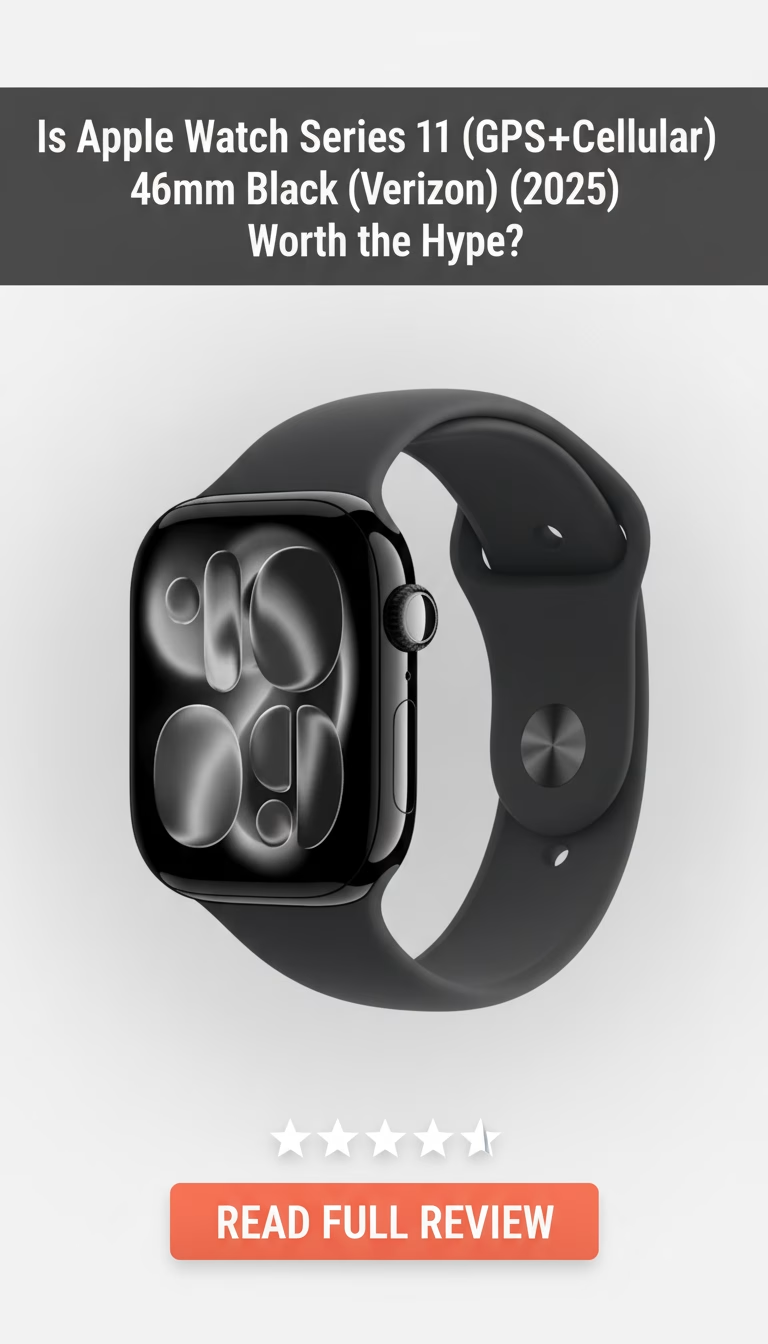
  • Apple Watch Series 11 (GPS+Cellular) 46mm Aluminum Case with Black Sport Band Jet Black

    Apple Watch Series 11 (GPS+Cellular) 46mm Aluminum Case with Black Sport Band Jet Black

    Apple Watch Series 11 (GPS+Cellular) 46mm Aluminum Case with Black Sport Band – M/L – Jet Black (Verizon) – (2025) Review 2026: Is It Worth Buying?

    Picture this: you’re heading out for a quick run,…

    Apple Watch Series 11 46mm Jet Black — The Larger Display Makes a Real Difference

    The 46mm is the bigger of Apple’s two Series 11 sizes, and the Jet Black aluminum finish is the most versatile color option — it pairs with any band and works in both casual and professional settings. At $529 for GPS+Cellular (or $429 GPS-only), it costs $30 more than the 42mm equivalent. That $30 buys a larger display, slightly longer battery life, and a better experience for anyone whose wrist can accommodate the size.

    46mm vs. 42mm — What the Extra 4mm Gets You

    The display area increase from 42mm to 46mm isn’t linear — you get approximately 15% more screen real estate. That translates to more readable complications, more text visible per notification, and better map legibility during navigation. For people who use their watch beyond basic time-telling and notification dismissal, the larger display is genuinely more functional.

    Battery life improves by roughly 2-3 hours over the 42mm, thanks to the larger physical battery. In practice: 24-28 hours with always-on display, daily workout tracking, and normal notification flow. Still a daily charger, but the margin means you can comfortably track sleep and still have battery for a morning workout before charging.

    The weight increase is minimal — about 4 grams. On wrists 155mm+ in circumference, the 46mm sits proportionally. Below that, it may look oversized. The Jet Black finish has a deeper, more saturated black than the standard Space Black of previous generations — it looks distinctly premium in person.

    Core Experience

    Everything that applies to the Series 11 42mm applies here: S10 chip, identical health sensors (heart rate, ECG, blood oxygen, temperature), WatchOS with Smart Stack, Apple Pay, Siri, cellular connectivity. The software experience is identical; you’re choosing between screen size and wrist proportion, not between feature sets.

    The larger display does make one meaningful difference in daily use: typing quick replies. The Series 11 46mm includes a QWERTY keyboard that’s marginally easier to use than on the 42mm, where the keys are cramped enough that most people default to voice dictation. At 46mm, hunt-and-peck typing is slow but viable for short responses.

    What Works

    • Larger display improves readability for complications, messages, and maps — the primary functional advantage over 42mm.
    • Jet Black finish is the most versatile color — works with every band style and setting.
    • Slightly longer battery life provides more comfortable margin for sleep tracking + morning use.
    • Same S10 performance, same health sensors, same software as the rest of the Series 11 lineup.
    • QWERTY keyboard is more usable at this size than on the smaller model.

    What Doesn’t

    • Still requires daily charging — the battery advantage over 42mm is 2-3 hours, not transformative.
    • $529 with cellular is expensive for a watch that needs replacing in 3-4 years as software support ends.
    • The 46mm may look oversized on wrists under 155mm circumference.
    • No new sensors or features over Series 10 — incremental upgrade at best for recent Apple Watch owners.
    • iPhone dependency remains absolute — no cross-platform compatibility.

    The Verdict

    If you’re choosing between 42mm and 46mm and your wrist can handle the larger size, the 46mm is the better buy. The display advantage is real and affects daily usability. The Jet Black finish is the safest aesthetic choice. The cellular vs. GPS-only decision is the same as with the 42mm: add $100 + monthly carrier fee only if you regularly leave your phone behind. For new Apple Watch buyers or those upgrading from Series 8 or earlier, this is a strong recommendation. Series 9-10 owners should wait.

    Pros

    • Full cellular independence from phone.
    • Excellent health and fitness tracking.
    • Bright, always-on Retina display.
    • Durable, lightweight aluminum construction.
    • Smooth performance with latest watchOS.
    • Great integration with iPhone and other Apple devices.

    Cons

    • Battery life could still be better.
    • Verizon cellular plan adds monthly cost.
    • Only works with iPhones, no Android support.