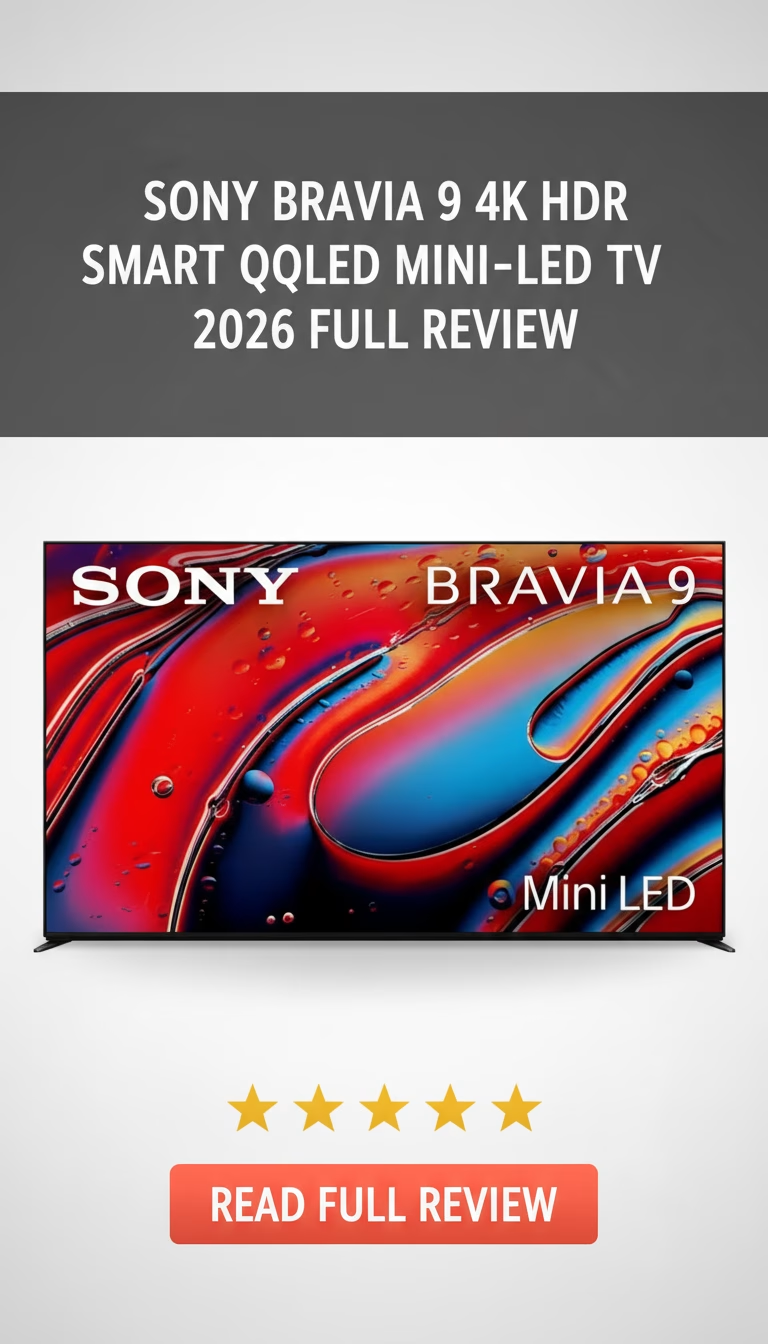
Sony BRAVIA 9 4K HDR Smart QLED Mini-LED TV Review 2026: Is It Worth Buying?
You’re probably here because you’re tired of scrolling through a gazillion TV options, all promising to be the “best e…
Sony BRAVIA 9 — Sony”s Best LCD TV, Period
The BRAVIA 9 is Sony”s flagship mini-LED: their best picture processing, their highest zone count, their brightest panel. At $2,000 for the 65-inch, it costs roughly the same as LG”s C4 OLED and Samsung”s QN90D — three fundamentally different approaches to the same goal. The BRAVIA 9 doesn”t beat OLED at contrast or Samsung at raw brightness. What it does is combine Sony”s processing superiority with enough hardware to produce the most natural-looking image in the LED TV category.
The Hardware Step-Up
Compared to the BRAVIA 7, the BRAVIA 9 approximately doubles the mini-LED dimming zone count — estimated at 600-700+ zones on the 65-inch. This matters in real content: a bright moon against a dark sky produces tighter, better-controlled blooming. Scene-wide dark-to-light transitions handle with less visible pumping between zones. The backlight simply has more granular control over where light appears on the screen.
Peak brightness reaches approximately 2,000-2,200 nits on 10% HDR windows — a significant jump from the BRAVIA 7”s ~1,400 nits. In bright rooms, the BRAVIA 9 competes with Samsung”s QN90D for glare resistance. HDR highlights have genuine intensity — sunlight reflections, neon signs, and fire carry real visual weight. Full-screen sustained brightness sits around 1,200 nits, which means even uniformly bright scenes maintain high luminance without aggressive dimming.
Processing: The XR Processor at Full Capability
The BRAVIA 9 uses the same XR Backlight Master Drive algorithm as Sony”s professional-grade monitors, adapted for consumer content. Zone-by-zone brightness is controlled with a precision that makes the zone count almost irrelevant compared to competitors — a 700-zone BRAVIA 9 controls blooming better than a 2,000-zone TCL QM8K because the software compensates for hardware limitations that raw zone count can”t solve on its own.
Color reproduction is reference-grade in Filmmaker Mode. Delta E averages under 1.5 without professional calibration — close enough to studio-mastered accuracy that most calibrators would struggle to improve it meaningfully. The combination of quantum dot color enhancement and Sony”s processing produces DCI-P3 coverage above 98% with correct saturation at all brightness levels. This means bright highlights maintain their color integrity instead of washing out toward white, which is a common problem on less sophisticated mini-LED implementations.
Motion handling is the best of any LED TV. 24fps film content is judder-free without any visible interpolation artifacts. Sports and fast action maintain clarity without blur or the soap opera effect. The motion processing works correctly at factory default settings — no manual tuning required, which is a genuine time-saver compared to TCL and Hisense TVs that ship with aggressive interpolation enabled.
Sound: Sony”s Acoustic Surface-Adjacent Technology
The BRAVIA 9 uses a multi-actuator audio system that physically vibrates the panel to produce sound. The effect localizes dialogue and effects to specific screen positions — an explosion on the left side of the screen sounds like it”s coming from the left side. This is more effective than Samsung”s OTS or LG”s down-firing speakers. Combined with a rear-mounted subwoofer unit, the BRAVIA 9 produces the best built-in audio of any non-Sony-A95L TV currently available.
For casual watching without a soundbar, the built-in system is genuinely usable. Bass has actual presence, dialogue stays centered and clear even during loud action sequences, and the spatial audio effect adds real immersion. A dedicated soundbar or receiver system still improves the experience, but the BRAVIA 9 is the TV most likely to make you delay that purchase.
Gaming: Full-Featured for Sony”s Flagship
Two HDMI 2.1 ports: 4K 120Hz, VRR (FreeSync and basic G-Sync), ALLM, and Dolby Vision Gaming — the last feature absent from the BRAVIA 7 and BRAVIA 5. Input lag measures approximately 8.5ms at 4K/120Hz, competitive with Samsung and LG flagships. PS5 exclusive features include Auto HDR Tone Mapping and Auto Genre Picture Mode, which automatically optimize picture settings per game.
Two HDMI 2.1 ports (versus four on Samsung and LG) remains the main competitive limitation. If you have a PS5, Xbox, and a gaming PC all needing 4K 120Hz simultaneously, you”ll need an HDMI switch or to choose which two devices get the premium ports.
Google TV
Same Google TV platform as the rest of the BRAVIA lineup. Fast, full-featured, with Chromecast, Google Assistant, and complete app support. The BRAVIA 9”s faster processor makes the interface slightly snappier than the BRAVIA 5, but the practical difference is marginal — both are smooth in daily use.
BRAVIA 9 vs. the Competition
Against the LG C4 OLED ($2,000): The C4 has perfect blacks, infinite contrast, and four HDMI 2.1 ports. The BRAVIA 9 is significantly brighter, has no burn-in risk, and produces more accurate color out of the box. Dark-room movie viewers favor OLED. Bright-room and mixed-use viewers favor the BRAVIA 9.
Against the Samsung QN90D ($1,800): Samsung is slightly brighter, has four HDMI 2.1 ports, and costs less. Sony has better color accuracy, better motion processing, and better built-in sound. The Samsung is the better gaming TV; the Sony is the better movie TV.
Against the Hisense U8N ($1,000): Hisense offers 80% of the brightness at half the price. Sony”s processing, color accuracy, and build quality justify the premium for buyers who prioritize image refinement over value per dollar.
The Bottom Line
- The most accurate color reproduction of any LED TV available.
- Blooming control that makes zone count comparisons misleading — processing trumps hardware.
- Built-in sound that actually works for daily viewing.
- Dolby Vision Gaming with competitive input lag.
- Only two HDMI 2.1 ports — a limitation for multi-device setups.
- $2,000 places it in OLED territory, where contrast performance is fundamentally superior.
- Google TV occasionally pushes promotional content on the home screen.
The BRAVIA 9 is Sony”s statement that processing sophistication matters more than spec-sheet numbers. If you believe that — and if you”ve compared Sony”s picture to Samsung or Hisense in a store and preferred it — the BRAVIA 9 is the best version of Sony”s philosophy available in an LED TV. It”s the flagship that earns its price through refinement rather than raw numbers.
Pros
- Exceptional brightness and contrast for HDR content.
- Deep, accurate colors really pop on screen.
- Excellent upscaling of lower-resolution sources.
- Integrated Acoustic Multi-Audio provides great sound.
- Google TV is fast, intuitive, and user-friendly.
Cons
- Premium price tag means it's a significant investment.
- Some minor blooming visible in very dark, specific scenes.
- Not quite as thin as competitor OLED models.
Leave a Reply