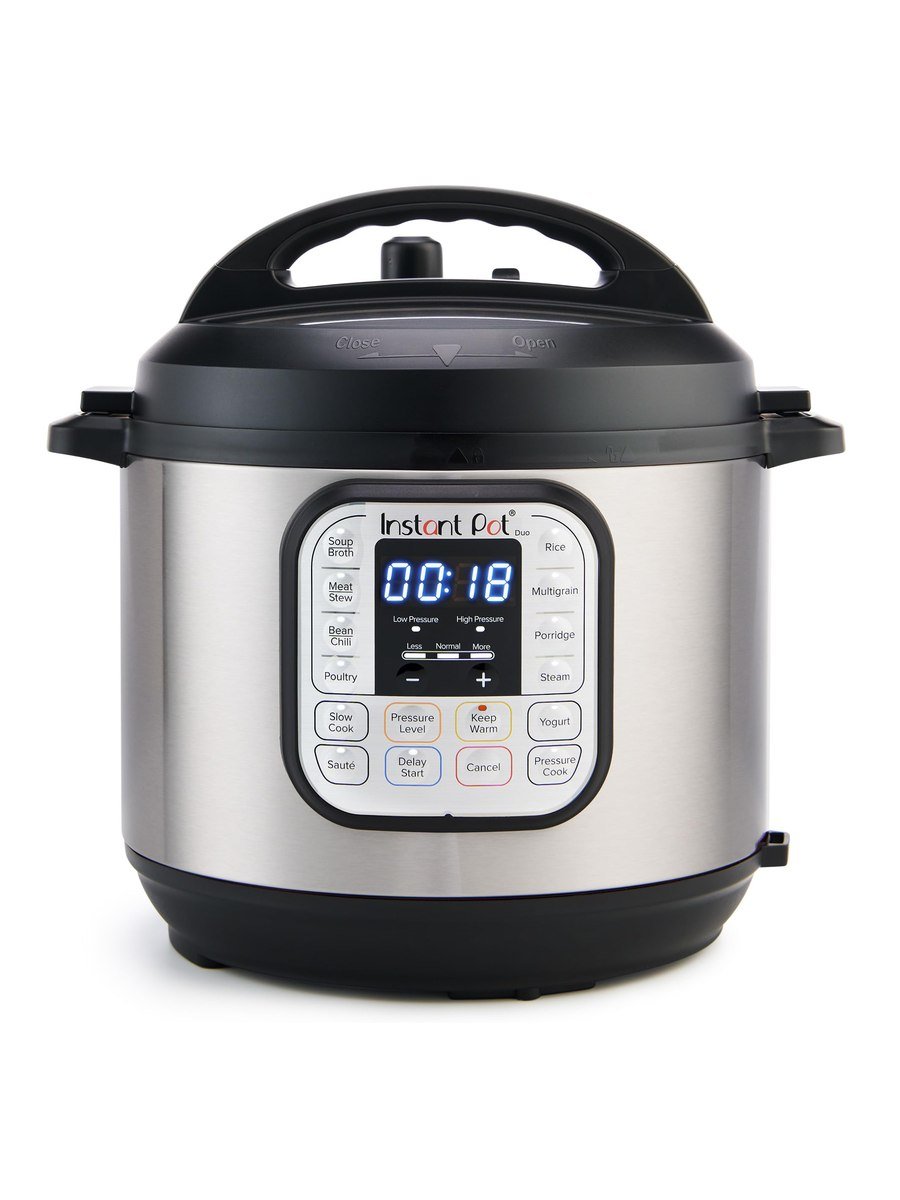
The Duo is the model that made Instant Pot a household word, and it is still the one we recommend to someone buying their first multicooker. Newer models add screens and air-frying lids; the Duo adds nothing and does the core job for less money.
What it replaces
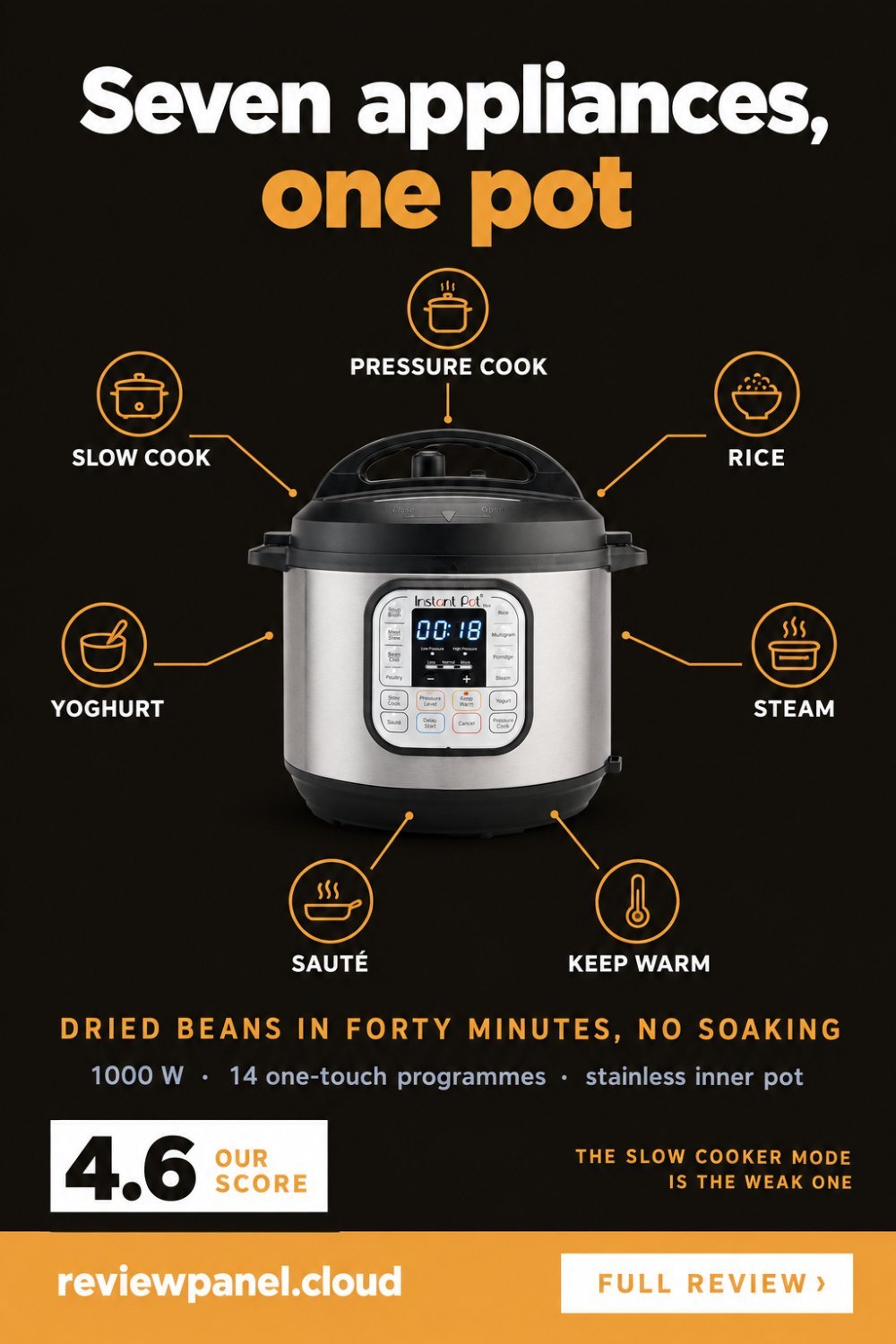
Pressure cooker, slow cooker, rice cooker, steamer, sauté pan, yoghurt maker and warmer. That list is marketing, but four of those are genuinely useful. Pressure cooking is the reason to own it: dried beans in forty minutes without soaking, a tough cut of beef falling apart in under an hour, stock in two hours instead of six. Sauté matters too, because browning in the same pot means one thing to wash.
The slow cooker function is the weakest. It works, but it heats from the base rather than the sides and runs cooler than a dedicated slow cooker, so recipes need adjusting.
Times for the things people actually cook
These are cook times at high pressure. None of them include the ten to fifteen minutes the pot spends coming up to pressure, or the release, which is the part that surprises new owners. Times shift with altitude and with how large you cut things.
| Food | At pressure | Release | Notes |
|---|---|---|---|
| Dried black beans, unsoaked | 35–40 min | Natural | Salt after, not before |
| Chickpeas, unsoaked | 45–50 min | Natural | Add a spoon of oil to cut foam |
| White rice | 3–4 min | 10 min natural | Equal parts rice and water |
| Brown rice | 20–22 min | 10 min natural | Slightly more water |
| Beef chuck, 2 in cubes | 35 min | Natural | Brown on sauté first |
| Whole chicken, 4 lb | 25 min | Natural | Breast reads 165°F |
| Chicken breast, boneless | 8–10 min | Quick | Longer makes it stringy |
| Chicken or beef stock | 45–60 min | Natural | Fill to two-thirds at most |
| Potatoes, 2 in chunks | 8 min | Quick | On the rack for steaming |
| Eggs, hard | 5 min | 5 min natural | Then straight into iced water |
| Steel-cut oats | 4 min | Natural | Foams; keep well under the line |
Natural release or quick release
This choice changes the food more than the cook time does. Natural release lets the pressure fall on its own over ten to thirty minutes, and the food keeps cooking gently while it happens. Use it for anything you want soft: beans, stocks, tough cuts, oats, and anything that foams, because a quick release will spit starchy liquid out of the valve. Quick release drops the pressure in a minute by opening the valve, and it exists to stop delicate food overcooking: vegetables, fish, boneless chicken breast, pasta. If a recipe does not say which, assume natural for meat and quick for vegetables.
The Burn message, and why it happens
This is the complaint that dominates owner feedback, and it is almost never a fault. The pot needs thin liquid to make steam, and the sensor in the base cuts in when the bottom gets too hot. Three things cause it. Too little thin liquid: a cup and a half is the working minimum for a six-quart pot, and thick sauces do not count. Fond left on the base after sautéing: deglaze and scrape it up before the lid goes on. And heavy ingredients sitting on the bottom: put tomato passata, cream and thick sauces on top of everything else and do not stir them in until the pressure has come down.
The fill lines matter
Two-thirds full is the limit for ordinary food and half full for anything that foams or swells, which means beans, rice, pasta, grains and oats. Overfilling is what blocks the valve, and a blocked valve is the one failure on a pressure cooker that is genuinely worth avoiding. Six quarts of capacity therefore means about four quarts of stew or three quarts of beans.
Living with it
Six quarts suits a family of four with leftovers. Fourteen one-touch programmes cover the common cases, and most people end up ignoring them and using manual pressure with a time. The lid seals with a twist, the float valve tells you when it is pressurised, and there are more than ten safety mechanisms including a lid lock that will not open under pressure.
The thing nobody mentions in the marketing: pressure cooking includes time to come up to pressure and time to release. A "ten minute" recipe is realistically twenty-five. It is still faster than the oven, but plan accordingly.
Cleaning and upkeep
The stainless inner pot and the lid are dishwasher safe. The silicone sealing ring absorbs smells — curry lives in it forever — so buy a second ring and keep one for savoury and one for sweet. The condensation collector clips off and needs emptying more often than you would think.
Two parts get forgotten until they cause trouble. The anti-block shield is the little metal cap under the lid beneath the steam valve; it unclips, and food debris behind it is the usual reason a pot stops holding pressure. The float valve should drop freely when you push it with a finger from above; if it sticks, its small silicone washer needs cleaning or replacing. Both take a minute and neither is mentioned until something goes wrong.
Should you buy it?
Buy the Duo if you want pressure cooking without paying for a touchscreen, and if beans, stews, stock and rice are a regular part of how you cook. Skip it if you already own a good slow cooker and a rice cooker, or if you want the air-frying lid, which is a different model. If you only ever cook for one, the three-quart version reaches pressure faster and takes far less cupboard space.
Key features
7-in-1 functions
Pressure cooker, slow cooker, rice cooker, steamer, sauté pan, yoghurt maker and warmer.
14 one-touch programmes
Soup, beans, rice, poultry, yoghurt and more, plus manual pressure.
1000-watt element
Reaches pressure quickly for a six-quart pot.
Stainless inner pot
Dishwasher safe, no coating to scratch.
Safety systems
More than ten, including overheat protection and a lid that locks under pressure.
Included accessories
Steam rack, condensation collector, rice paddle, soup spoon and measuring cup.
Pros & cons
What we like
- Pressure cooking genuinely changes how you cook beans and tough cuts
- Sauté in the same pot means one thing to wash
- Stainless inner pot and lid are dishwasher safe
- Over ten safety mechanisms including a locking lid
- 14 one-touch programmes plus full manual control
- Costs less than the touchscreen models
What could be better
- Slow cooker mode runs cooler than a dedicated one
- Sealing ring holds onto strong smells
- Come-to-pressure time is not in the recipe time
Specifications
Frequently asked questions
Much faster for beans, stock and tough cuts. But add ten to fifteen minutes for the pot to reach pressure and time to release it, so a "ten minute" recipe takes about twenty-five in total.
It works but it heats from the base and runs cooler than a dedicated slow cooker. Recipes usually need a higher setting or more time.
Six quarts suits a family of four with leftovers. Three quarts is for one or two people; eight quarts is for batch cooking and large cuts.
The silicone sealing ring absorbs strong aromas. Keep two rings, one for savoury and one for sweet dishes, and replace them yearly.
Yes, and so can the lid. Only the base with the electronics must be wiped by hand.
Almost always because the base got too hot, not because the pot is faulty. Use at least a cup and a half of thin liquid, scrape the fond off the base after sautéing, and lay thick things like tomato passata or cream on top without stirring them in.
Natural release for anything you want soft or anything that foams: beans, stock, tough cuts, grains and oats. Quick release for food that overcooks in seconds: vegetables, fish, boneless chicken breast and pasta.
Two-thirds for ordinary food and half for anything that foams or swells, which covers beans, rice, pasta, grains and oats. Overfilling is the usual reason a steam valve blocks.
Final verdict
Still the multicooker to buy first. Pressure cooking and sauté are the functions that earn the counter space; the slow cooker mode is the weak one.
What owners report
Gathered from what long-term owners consistently say, not from a single test.
The sealing ring holds onto garlic and spice, and buying a second ring for sweet dishes has become near-standard advice. The "Burn" warning is the most common thing owners hit, usually from too little liquid or sauce catching on the base. Slow cooking is the one function that disappoints people arriving from a dedicated slow cooker. Where to put the lid is a small problem faced every single day, and the slot on the handle is what solves it.
Reader rating
Found this review helpful?
Pin it to one of your boards and come back to it whenever you need a reminder.

No comments yet.
Join the discussion. Comments are moderated before appearing.