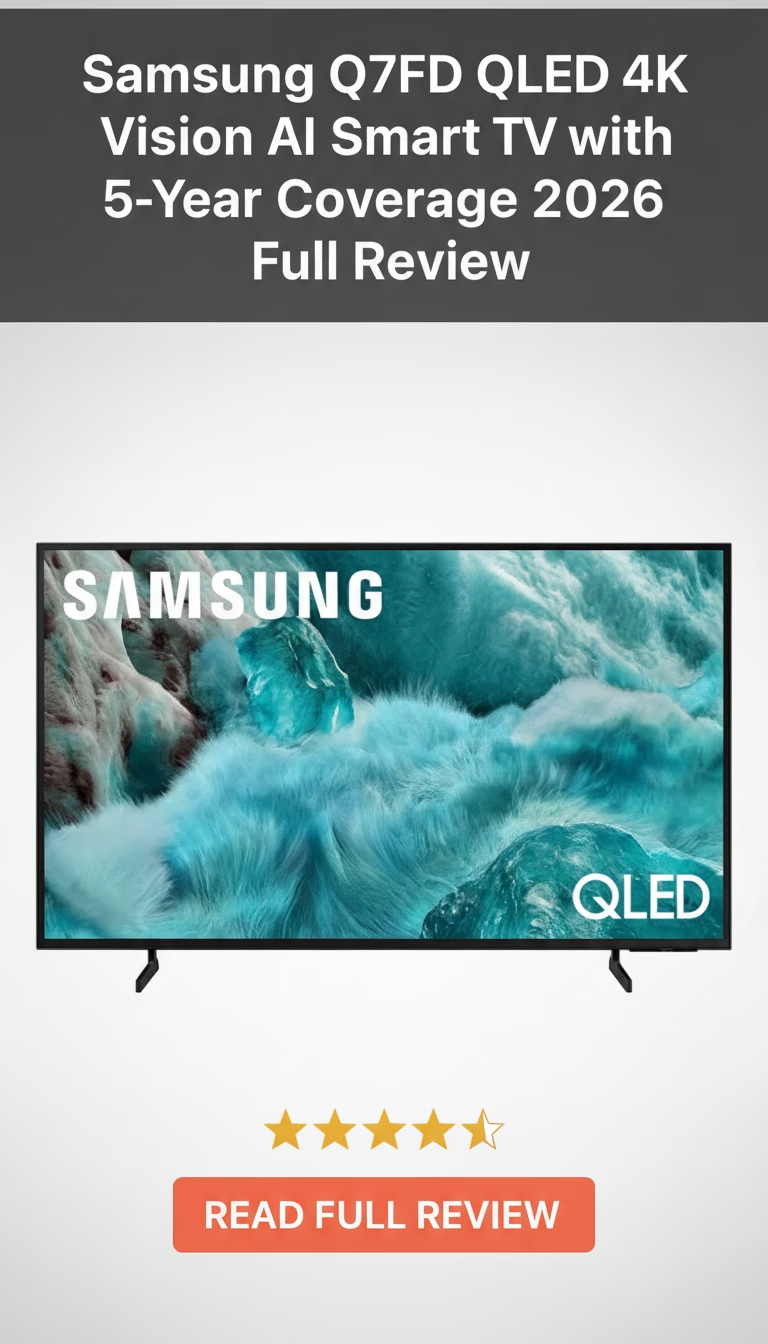
Samsung Q7FD QLED 4K Vision AI Smart TV with 5-Year Coverage Review 2026: Is It Worth Buying?
Okay, so you’re probably here for the same reason I was a few months ago: your old TV is starting to look…
Samsung Q7FD — A $400 QLED With a 5-Year Warranty That Changes the Math
The Samsung Q7FD occupies an unusual position: it”s a mid-range QLED TV priced like a budget model, bundled with warranty coverage that no competitor matches at this price. At roughly $400 for the 55-inch, it undercuts the TCL Q7 and Hisense U7 while including a 5-year manufacturer warranty that would cost $80-120 as an add-on from Best Buy or Amazon. That warranty alone shifts the value equation significantly.
The 5-Year Coverage, Explained
Samsung bundles comprehensive warranty coverage directly with the Q7FD — no separate purchase, no registration hoops. It covers panel defects, dead pixels, power supply failures, and component malfunctions. Accidental damage is not included. For a $400 TV, this essentially guarantees that if the display develops any manufacturing-related fault within five years, Samsung repairs or replaces it at no cost.
Why this matters: budget and mid-range TVs historically have the highest failure rates in years 2-4, after the standard 1-year warranty expires. A $400 TV that fails in year 3 is usually a total loss — repair costs exceed replacement cost. The 5-year coverage eliminates that risk entirely. No other TV under $600 offers this level of protection from the manufacturer.
QLED Picture Quality
The Q7FD uses a VA panel with Samsung”s Quantum Dot color layer. Contrast ratio is strong for the price — around 4,500:1 native, which produces reasonably deep blacks in moderately lit rooms. Black uniformity is average, with some visible backlight bleed in the corners that shows up in very dark scenes when viewed in a pitch-black room. In any room with ambient light, it”s a non-issue.
Peak brightness hits approximately 700 nits in HDR highlights — enough for HDR10 and HDR10+ content to look noticeably better than SDR, but well below the 1,500+ nit flagships where HDR truly transforms the image. Bright specular highlights have some pop but lack the intensity that makes HDR content feel dramatically different from standard dynamic range.
Color accuracy is good for the category. Quantum Dots widen the color gamut beyond what standard LED TVs achieve, covering roughly 90% of DCI-P3. Reds and greens are more vivid than comparably priced Toshiba or Insignia models without looking oversaturated. Samsung”s Vision AI processing handles upscaling competently — 1080p cable and streaming content gets reasonable sharpening and noise reduction without obvious artifacts.
Viewing Angles: The VA Trade-Off
VA panels trade viewing angle performance for contrast. Sitting directly in front, the Q7FD looks excellent. Move 30+ degrees off-center and colors desaturate, contrast drops, and the image washes out noticeably. For a living room where most viewers sit within 20 degrees of center, this is fine. For a wide room where people watch from sharp angles — a kitchen-adjacent family room, for example — an IPS-based alternative like the LG UT8000 handles off-axis viewing better, though with worse head-on contrast.
Tizen OS and Smart Features
Tizen runs well on the Q7FD”s hardware. App load times are slightly slower than flagship Samsung TVs — about 3-4 seconds for Netflix versus under 2 seconds on the S90F — but menu navigation is smooth and responsive. Samsung”s content discovery interface surfaces recommendations across services. All major streaming apps are available. Bixby, Alexa, and Google Assistant voice control all work through the remote microphone.
The solar-charging remote is the same unit Samsung includes with their $2,000+ models — a genuine luxury feature trickling down to the budget tier. No battery replacement needed.
Gaming Capabilities
Three HDMI ports, one supporting 4K 60Hz and two supporting 4K 120Hz with VRR and ALLM. Input lag at 4K/60Hz in Game Mode: approximately 10ms. At 4K/120Hz: approximately 12ms. FreeSync Premium Pro support for AMD GPUs and basic VRR for everything else. The Game Bar overlay provides real-time performance metrics.
For PS5 and Xbox Series X owners playing at 4K/60Hz (most console games), the Q7FD performs identically to TVs costing twice as much. The 120Hz mode works but the panel”s motion clarity at 120Hz isn”t as crisp as IPS or OLED alternatives — fast-moving objects show slight smearing in dark-to-light transitions.
What You Give Up at $400
- No local dimming — the edge-lit backlight can”t achieve the contrast precision of full-array or mini-LED TVs. Dark scenes in fully dark rooms reveal the most backlight uniformity issues.
- Viewing angles are limited by the VA panel. This is a front-and-center TV.
- No Dolby Vision support — Samsung uses HDR10+ exclusively. Content availability for both formats is roughly equal on streaming platforms.
- Built-in speakers (20W) handle dialogue clearly but have no meaningful bass. A $50-80 soundbar is a near-essential accessory.
The Verdict
The Q7FD is a straightforward value proposition: $400 for a QLED panel with solid color performance, backed by a 5-year warranty that no competitor matches. The closest alternatives — TCL S4 at $280, Hisense A7 at $300 — cost less but use standard LED backlighting without quantum dots and include only 1-year warranties. The TCL Q6 at $350 matches the QLED spec but adds only a 2-year warranty.
For a primary living room TV where the screen is viewed mostly from the front, in a room with some ambient light, and where the TV needs to last more than 2-3 years without worry, the Q7FD makes strong financial sense. The 5-year warranty is the deciding factor — it turns a $400 purchase into a $400 investment with a guaranteed floor on reliability.
Pros
- Picture quality is vibrant and bright
- AI upscaling genuinely improves content
- Smart features are quick and intuitive
- Five-year warranty is a huge bonus
- Sleek design looks great in any room
Cons
- Black levels aren't quite OLED deep
- Built-in speakers are just decent
- Premium price point might deter some
Leave a Reply