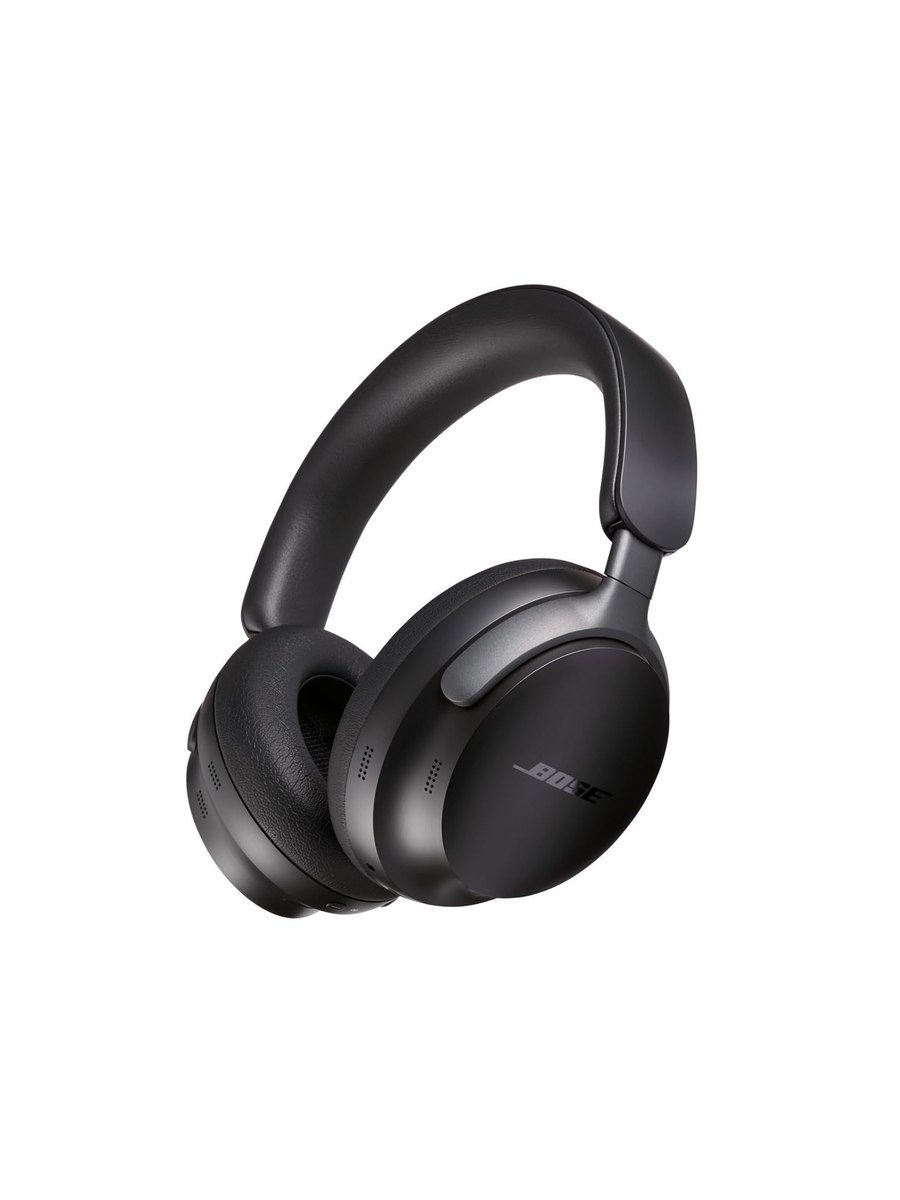
The most comfortable cancelling headphones you can buy, with the most natural transparency mode. Battery life is the one number that lags the field.
- Best for
- Long sessions where comfort matters more than a spec sheet
- Key highlight
- CustomTune measures your ear canal at every power-on
- Sound4.6
- Noise cancelling4.7
- Comfort5.0
- Battery4.0
- Features4.5
As an Amazon Associate we earn from qualifying purchases. Links on this page may be affiliate links; we may earn a commission at no extra cost to you.
Bose has been doing this longer than anyone, and the QuietComfort Ultra shows it in the places that are hard to copy: the pressure distribution, the way transparency sounds, the fact that you forget you are wearing them. Then it adds a spatial audio mode that is either the headline feature or a battery tax, depending on who you ask.
Comfort
This is the part that sells the headphones. The headband spreads pressure evenly instead of clamping at two points, the cushions are soft without being hot, and the metal arms keep the weight low. Wearing glasses does not break the seal the way it does on stiffer designs. If you have ever taken headphones off after two hours because your ears ached, this is the pair to try.
Noise cancelling and CustomTune
Quiet Mode is excellent — not quite the deepest hush on aircraft rumble, but very even across frequencies, which matters more than a headline number. Aware Mode is the best transparency implementation on a full-size headphone; it sounds open rather than processed. CustomTune runs a short tone at power-on to measure your ear canal and adapts both the cancelling and the frequency response to it, which is why two people can disagree about how these sound.
Immersive Audio
Bose's spatial mode places the sound in front of you rather than inside your head, and unlike most spatial audio it works with any source — stereo, any app, any device. On film and live recordings it is genuinely convincing. On dense studio music it can smear detail, and it costs you battery: Bose rates twenty-four hours normally and eighteen with Immersive Audio on. The second-generation model raises those to thirty and twenty-three.
Sound and connectivity
The tuning is clean and slightly warm, less bass-forward than Sony's, and easy to listen to for long stretches. There is an equaliser in the Bose app but it is simpler than Sony's. Bluetooth 5.3 with multipoint holds two devices and switches without drama. aptX Adaptive is supported on compatible Android phones; there is no LDAC.
Where it falls short
Battery life is the weak spot: twenty-four hours is fine, but it is the lowest number in this group, and turning on the marquee feature drops it further. The touch strip for volume is less reliable than a physical control. And these are expensive even before you count the fact that they do not include a hard case upgrade or a USB audio mode.
Should you buy it?
Buy the QuietComfort Ultra if comfort over long sessions is your first requirement, or if you want the most natural-sounding transparency mode available. Skip it if you want the longest battery, the deepest cancelling number on paper, or the cheapest route to good noise control.
Key features
CustomTune
Plays a tone at start-up to measure your ear and adapt cancelling and EQ.
Immersive Audio
Places sound in front of you and works with any stereo source.
Aware Mode
Transparency that sounds open rather than microphone-fed.
ActiveSense
Clips sudden loud noises while you are in Aware Mode.
Bluetooth 5.3 with multipoint
Two devices connected at once, with aptX Adaptive on Android.
Even-pressure headband
Spreads weight across the crown instead of two contact points.
Pros & cons
What we like
- Best-in-class comfort over long wear
- Aware Mode sounds genuinely open
- CustomTune adapts cancelling to your ears
- Immersive Audio works with any app or source
- Even cancelling across frequencies, not just rumble
- Reliable two-device multipoint
What could be better
- 24-hour battery is the weakest here
- Immersive Audio cuts battery to about 18 hours
- Touch strip is fiddly compared with a button
Specifications
Frequently asked questions
It is Bose's spatial mode. It widens the stage and works with any app, but it costs about six hours of battery. Try it on film and live recordings first.
Bose rates 24 hours with cancelling on, or about 18 with Immersive Audio. The second-generation model raises that to 30 and 23.
It is more even across frequencies; Sony pulls ahead on mid-range voices. Most listeners will find both excellent and pick on comfort instead.
No. They use SBC, AAC and aptX Adaptive. LDAC is a Sony format.
Yes, with the included 2.5 mm to 3.5 mm cable. Immersive Audio still works when wired if the headphones are powered.
Final verdict
The most comfortable cancelling headphones you can buy, with the most natural transparency mode. Battery life is the one number that lags the field.
Reader rating

No comments yet.
Join the discussion. Comments are moderated before appearing.