Choose the lid before anything else. Insulation claims are hard to compare from one bottle to the next, but the lid decides whether the bottle can ride in a bag, how often you drink from it, and how annoying it is to wash.
A quick way to check any bottle: fill it, close the lid, and lay it on its side on a paper towel for a few minutes. Shake it over the sink first if you are brave. What you see tells you more than the product description will.

What actually matters
Five things decide whether an insulated bottle suits your day. Each one has a check you can run before you commit.
The lid
Lids fall into three broad groups. A straw lid lets you drink without tilting the bottle, which suits a desk or a car. A spout or push-button lid is more compact and usually easier to close firmly. A plain screw cap is the simplest and has the fewest parts to wash, but it means tipping the bottle back every time.
The question to ask is where the bottle will spend its day. If it sits upright in a cup holder or on a desk, a small amount of seepage is a minor annoyance. If it goes into a bag next to a laptop, a lid that actually seals matters far more than any other feature.
Be careful with the words on the box. "Leak resistant" and "leakproof" are not the same promise. The Stanley Quencher H2.0 is described in our review as leak resistant rather than leakproof, and owners mention that many only discover this after it has happened once. The Owala FreeSip, by contrast, has a locking push-button lid, and owners say it stays dry in a bag.

Count the pieces, too. A lid with a removable straw, a gasket and a latch has more places for residue to collect. That is not a reason to avoid one, just a reason to know what your cleaning routine will involve.
The size
Bigger is not automatically better. A large bottle means fewer refills, but it is heavy when full, and a bottle you leave at home because it is awkward does no good.
Three checks help:
- Cup holder. Measure the opening in your car or on your bike, or take the bottle out and try it. Many large tumblers are wide at the base. The Stanley Quencher stands out here because its base is narrow enough for standard car cup holders despite holding 40 oz.
- Bag pocket. Check the depth and width of the side pocket on the bag you carry most. The Owala FreeSip 24 oz measures 3.24 inches wide and 10.68 inches tall, which gives you a number to hold against your own pocket.
- Full weight. Fill any bottle you are considering with water and carry it around the house for a few minutes. Water is heavy, and a handle changes how a large bottle feels in one hand.

Think about how much you drink between refill points, too. If there is a tap at your desk, a smaller bottle you refill is often fine. If you spend long stretches in the car or on the move, a larger one saves trips.
The insulation
Insulated stainless bottles generally rely on a double wall to slow heat transfer. What differs is how makers describe the result, and the numbers are not always comparable.
The Stanley Quencher keeps drinks cold for about 9 hours and holds ice for about 40. The Owala FreeSip keeps drinks cold for up to 24 hours. Those are different kinds of claim, so do not read them as a straight contest. Ice retention and "cold" are different measures.
The practical check is to ask what you need. If you want ice still in the cup the next morning, look for an ice figure. Owners of the Stanley say finding ice still there the next day is the praise that repeats most. If you just want water that stays cold through a workday, a cold-hours figure is enough.

Hot drinks are a separate question. Do not assume an insulated bottle is rated for them. The Owala FreeSip, for example, is not for hot drinks. Check what the maker says before pouring coffee in.
The material and finish
Stainless steel is the sensible default for an insulated bottle, and both bottles we cover use it. The Stanley Quencher is 90% recycled stainless and BPA free. The Owala is free of BPA, lead and phthalates.
The outside finish is the part that wears. Some Quencher owners say the powder coat chips over time against metal edges and car consoles, with no effect on insulation. If you are hard on your gear, expect cosmetic wear and decide whether you mind.
The cleaning
This is the factor people check last and regret first. Before buying, look at three things.
- Mouth width. Can you get a hand or a brush to the bottom? The Owala FreeSip has a wide opening that makes ice and cleaning easier.
- Dishwasher rules. They vary by part. The FreeSip lid is dishwasher safe but the body is hand wash only. Owners of the Stanley say the body comes through the dishwasher fine, though the straw needs washing separately.
- Drying. Leave the lid off and let everything dry. A bottle sealed while damp tends to smell, whatever it is made of.
What to ignore
Colors and brand buzz. A popular bottle is not necessarily the right one for you. Check whether the lid suits your bag and your routine.
The biggest insulation number. If you finish a bottle within a day, a longer-duration figure adds nothing for you. Choose the figure that matches how you actually use it.
Lid modes for their own sake. More settings sound useful, but judge a lid by how you will use it and how it cleans, not by how many positions it has.
Accessories. Boots, straws, carry straps and extra caps are nice, but they should not drive the decision. Check that the core bottle works for you first.
Common mistakes
- Buying the largest size. A bottle that is too heavy to carry stays on the counter. Match the size to where it will actually go.
- Trusting "leak resistant" in a bag. That wording is not a promise of a sealed bottle lying on its side. Test with water over a sink before you trust it near electronics.
- Skipping the cup-holder check. A bottle that does not fit the car is a bottle you will not take in the car.
- Putting a hand-wash body in the dishwasher. Read the care notes for each part. Lid and body often have different rules.
- Ignoring the weak point. Every bottle has one. For the Owala FreeSip, owners report the carry loop breaking. For the Stanley Quencher it is the lid seal in a bag. Know yours before you buy.
- Sealing it while wet. Rinse, open and dry. It takes a minute and keeps the bottle usable.
Which kind of buyer should pick which kind of bottle
| If your day looks like this | Look for |
|---|---|
| Mostly at a desk or in the car, one big cup you refill rarely | A large tumbler with a handle, a narrow base and a straw |
| Commuting with a bag, plus gym or office | A mid-size bottle with a locking lid that seals |
| You want ice to last overnight | A bottle with a stated ice-retention figure |
| You hate washing by hand | A bottle whose body is stated as dishwasher safe |
| You want hot drinks too | A bottle the maker says is rated for hot liquids |
If you are choosing between a big tumbler and a mid-size bottle, ask where it will spend most of its time. Upright and stationary points to the tumbler. In and out of a bag points to the bottle.
Where our catalog products fit
We cover two insulated bottles that suit quite different routines. Neither is the right answer for everyone, and the trade-offs are clear.
For desk and car: the Stanley Quencher
The Stanley Quencher H2.0 FlowState Tumbler, 40 oz is built for the person who wants to drink more water at a desk or in the car. The handle makes a full cup manageable in one hand, and the base is narrow enough for standard car cup holders. The FlowState lid rotates between a straw opening, a drink opening and full cover, and the straw is reusable and replaceable.
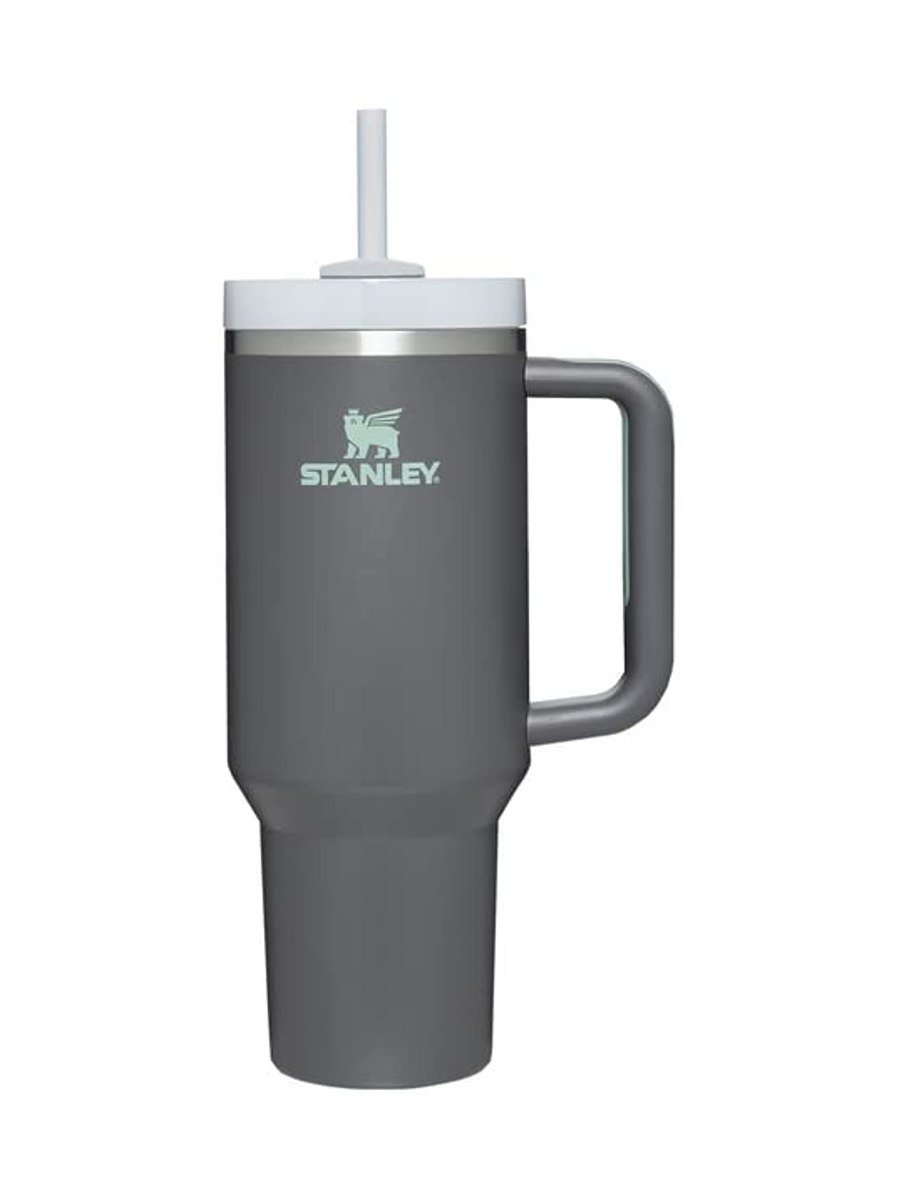
A well-made insulated cup with a handle and a cup-holder base, which is why this one stuck. The lid is leak resistant, not leakproof.
As an Amazon Associate we earn from qualifying purchases. Links on this page may be affiliate links; we may earn a commission at no extra cost to you.
It holds ice for about forty hours and keeps drinks cold for about nine, and owners confirm the ice claim. The catches are plain. The lid is leak resistant rather than leakproof, it is heavy when full, and it is not the one to toss in a bag. It also costs far more than an unbranded equivalent, so check the current price.
Other sizes are available: 14, 20, 30 and 64 oz as well as the 40 oz. If the full-size cup feels like too much, a smaller one may suit you better.
For one bottle everywhere: the Owala FreeSip
The Owala FreeSip 24 oz is the one to look at if a single bottle has to cover the car, the office, the gym and a bag. The spout lets you sip upright through the built-in straw or tilt back and swig. The push-button lid locks, and the carry loop doubles as the lock.

It keeps drinks cold for up to 24 hours, has a wide opening for ice and cleaning, and comes with a limited lifetime warranty. Owners say it stays leak-proof in a bag, and several say they prefer it to a Stanley. The downsides are a hand-wash-only body, no hot drinks, and a carry loop that owners report breaking. Some also feel it is expensive for a bottle, so check the current price.
Against the Stanley, the trade is clear. The FreeSip is smaller, holds 24 fl oz instead of 40 oz, and is the safer choice for a bag. The Quencher holds more and has a handle, but it is the better pick if it stays upright.
The short version
Start with where the bottle will travel, and pick the lid for that. Then size it against your cup holder and bag. Then check what the insulation claim actually measures. Last, read how each part is cleaned and decide whether you will really do it.
Found this review helpful?
Pin it to one of your boards and come back to it whenever you need a reminder.




No comments yet.
Join the discussion. Comments are moderated before appearing.