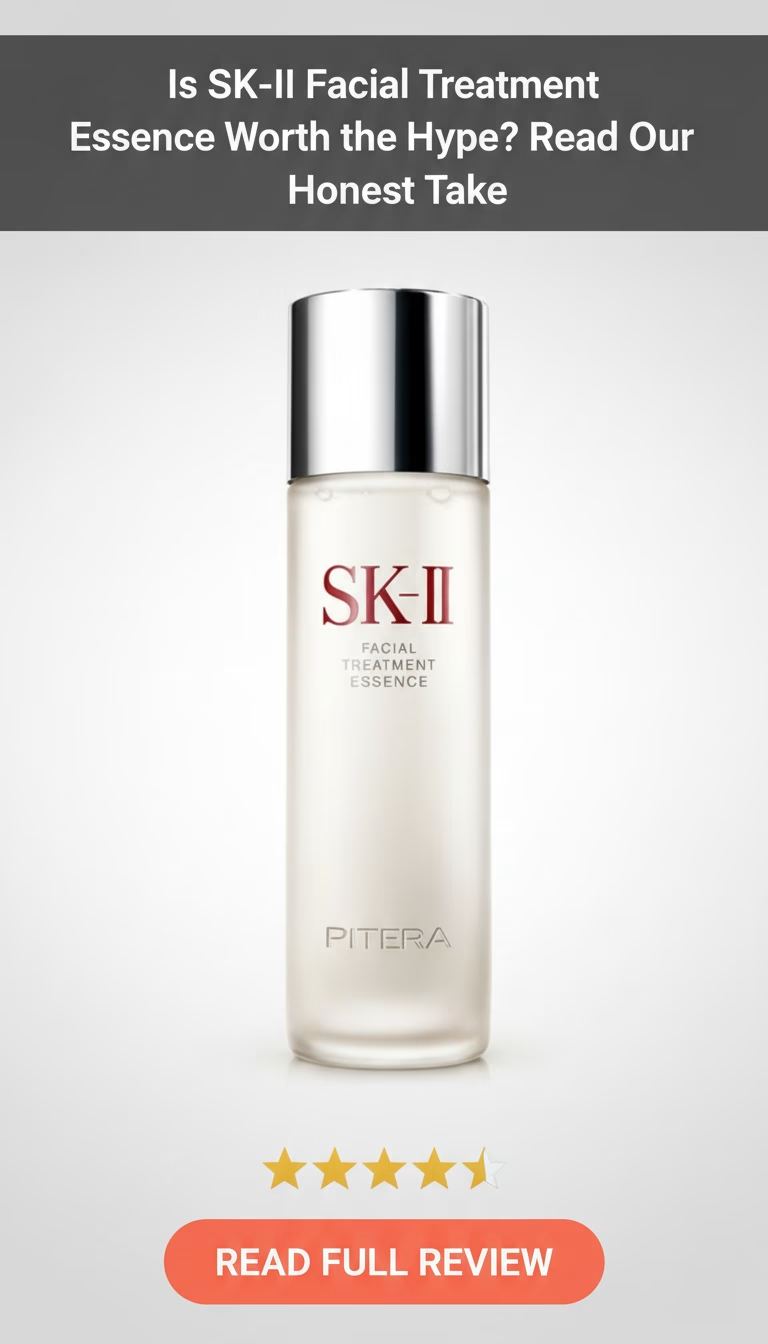
SK-II Facial Treatment Essence Review 2026: Is It Worth Buying?
You know that feeling, right? That endless quest for *the one* – the skincare product that actually delivers on its promises, the one…
SK-II Facial Treatment Essence — Is Fermented Yeast Worth $185?
SK-II’s Facial Treatment Essence (FTE) has been the brand’s flagship since 1980. The legend: scientists noticed sake brewery workers had aged hands but remarkably smooth, young-looking skin on their faces — and traced it to a specific yeast strain (Galactomyces) used in fermentation. That strain now produces Pitera, the core ingredient in every bottle of FTE. A 230ml bottle costs about $185 on Amazon, making it one of the most expensive essences on the market. The question isn’t whether it works — 44 years of loyal users confirm something is happening — but whether what it does is worth ten times what alternatives cost.
What Pitera Actually Is
Pitera is a fermented filtrate — the liquid byproduct of fermenting Galactomyces yeast under controlled conditions. It contains over 50 micro-nutrients: vitamins (B2, B5), amino acids (14 of them), minerals, and organic acids. SK-II claims Pitera mimics the skin’s Natural Moisturizing Factor (NMF) — the cocktail of compounds that keeps healthy skin hydrated and functioning properly. The FTE is over 90% Pitera by composition, with minimal added ingredients (butylene glycol, pentylene glycol, and sodium benzoate as preservative).
The texture is literal water — clear, thin, completely fluid. There’s no viscosity, no gel-like quality, nothing you’d associate with a serum. You pour it into your palm and it runs through your fingers if you’re not quick. It absorbs instantly — faster than water because of its smaller molecular structure. No residue, no film, no stickiness. There is, however, a distinctive smell: a fermented, yeasty, slightly sake-like aroma. It’s not strong, and it dissipates within 30 seconds of application, but it’s there. Some people barely notice it; others find it off-putting. It’s an authentic byproduct of the fermentation, not an added fragrance.
3-Month Test
Applied twice daily — morning and evening — after cleansing, before all other products. A quarter-sized pour into the palm, patted gently onto the face and neck.
Week 1-2: The initial impression is underwhelming. It feels like water, absorbs like water, and leaves no perceptible trace. Skin might feel slightly smoother after application, but it’s subtle enough to be placebo. No immediate glow, no instant plumping, no visible change. This is where many people give up — they’ve spent $185 and feel like they’re splashing overpriced water on their face.
Week 3-4: Texture changes became noticeable. The cheeks felt smoother, less rough under fingertips. Products applied afterward — serums, moisturizers — seemed to absorb more evenly. Skin had a slight clarity improvement: not brighter exactly, but less muddy. The uneven patches of tone that make bare skin look tired started to recede.
Week 5-8: The crystal clear claim gained credibility. Under natural light, skin looked notably more luminous — the kind of even, healthy reflectance that people attribute to good genetics or expensive facials. Fine lines around the eyes and mouth appeared shallower. Post-inflammatory marks from old breakouts faded faster than baseline. The overall impression was skin that looked calmer, more balanced, and more alive.
Week 9-12: The cumulative effect plateaued into a new normal. Skin maintained the improved texture and clarity without further dramatic changes. The barrier felt stronger — less reactive to seasonal shifts, less prone to the tight-dry-oily cycle. Occasional breakouts resolved faster and left less marking. Skipping the FTE for a few days produced a noticeable regression — skin looked slightly duller and felt less smooth — which was perhaps the most convincing evidence that it was actually doing something.
What FTE Does and Doesn’t Do
It does: improve skin texture and clarity, create a more even-toned complexion, enhance the absorption and effectiveness of subsequent products, support barrier function, and create a subtle but genuine luminosity over time.
It does not: erase deep wrinkles, provide significant firming or lifting, replace retinoids for collagen building, replace vitamin C for pigmentation, or replace sunscreen for aging prevention. It’s a foundational product — it makes skin healthier so that everything else works better.
The Pricing Reality
At $185 for 230ml, each application costs roughly $1.00-1.50 depending on how generous your pour is. The bottle lasts approximately 4-5 months with twice-daily use. That’s $37-46/month. For context: a good retinol serum costs $15-30/month, a vitamin C serum $10-25/month, and a quality moisturizer $15-40/month. The FTE adds $40/month on top of your existing routine for what amounts to a prep and glow step. Is it necessary? No. Does it make a visible difference? In my experience, yes.
Alternatives Worth Considering
Missha Time Revolution First Treatment Essence ($22 for 150ml) uses a similar Galactomyces ferment filtrate. It’s not identical to Pitera — different yeast strain, different fermentation conditions — but the concept is the same. In blind tests, many users can’t distinguish between the two. If you want to test whether fermented essence works for your skin, Missha is the obvious starting point before committing to SK-II pricing.
COSRX Galactomyces 95 Tone Balancing Essence ($19 for 100ml) is another Korean alternative with similar Galactomyces content. Thicker texture than SK-II, slightly different feel, but targeting the same outcomes. The Ordinary has no direct equivalent — their ferment-based products don’t concentrate on Galactomyces specifically.
What Works
- Skin clarity and luminosity improvement is genuine and visible by week 4-6 of consistent use.
- Texture refinement is measurable — smoother surface, less roughness, more even product absorption.
- Completely weightless — zero interference with any other product, routine, or makeup application.
- Barrier support is notable — skin becomes less reactive and recovers from irritation faster.
- 4-5 month bottle life makes the per-use cost more palatable than the sticker price suggests.
What Doesn’t
- $185 for what is essentially fermented yeast water — Missha offers a similar concept for $22.
- Results take 4+ weeks to become visible, and first-time users often feel they’re paying for nothing during weeks 1-2.
- The fermented smell is a legitimate deal-breaker for some people.
- Won’t replace targeted treatments for wrinkles, pigmentation, or acne — it’s supplementary, not corrective.
- The pour-from-bottle format wastes product — a pump or spray nozzle would improve dispensing precision.
The Verdict
SK-II FTE is a legitimate product that produces genuine improvements in skin texture, clarity, and overall health over consistent use. The science behind Galactomyces ferment filtrate is supported by research, and the observable results across thousands of users aren’t mass delusion. The problem is price — Missha’s equivalent costs 1/8th as much and uses similar technology. Try Missha first. If your skin responds well to Galactomyces ferment, then you know the approach works for you. At that point, whether SK-II’s specific Pitera formulation justifies the 8x premium becomes a personal value judgment rather than a blind gamble.
Pros
- Seriously improves skin texture and clarity.
- Noticeably reduces visible fine lines.
- Leaves skin feeling deeply hydrated.
- Gives a healthy, undeniable radiant glow.
- Absorbs super fast, feels weightless.
Cons
- It's a huge splurge, very expensive.
- Subtle, distinct ferment scent isn't for everyone.
- Takes weeks to see real noticeable changes.
- Might not suit super sensitive or reactive skin.
Leave a Reply