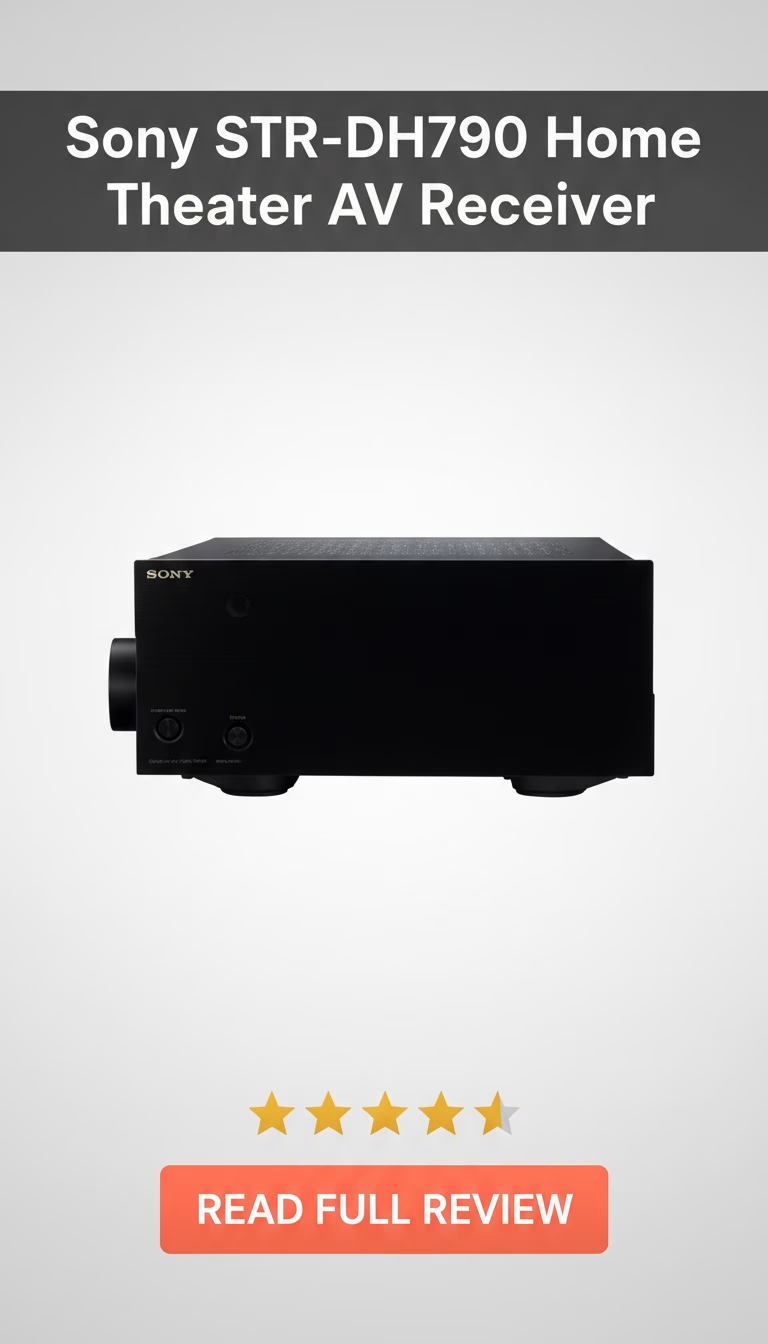
Sony STR-DH790 7.2-Channel Home Theater AV Receiver Review 2026: Is It Worth Buying?
Let’s be real for a second: you’ve probably got a pretty decent TV, maybe even a 4K monster, right? But the sound?…
Sony STR-DH790 — The Cheapest Path to Dolby Atmos in a Receiver
The Sony STR-DH790 is a 7.2-channel AV receiver with Dolby Atmos and DTS:X support, priced around $350. It”s the least expensive receiver that supports height channels for object-based surround sound. The 5.2-channel DH590 below it handles traditional surround only; the jump to the DH790 adds the third dimension. For a $100 premium over the DH590, you get Atmos capability that transforms movie soundtracks.
Atmos on a Budget
The DH790 drives 7.2 channels: five ear-level speakers, two height speakers (either ceiling-mounted or Atmos-enabled upward-firing modules), and two subwoofer outputs. In a 5.1.2 configuration (the most common Atmos layout), you get the standard surround field plus overhead effects from two height speakers.
145 watts per channel (6 ohms, 1kHz, 1 channel driven). Real-world power with all channels active: approximately 60-70 watts per channel. Sufficient for bookshelf speakers and moderate-efficiency floor-standers in rooms up to 350 square feet.
Atmos decoding handles both Dolby Atmos and DTS:X object-based soundtracks. The improvement over non-Atmos surround is immediately audible in well-mixed content: overhead effects create a convincing sense of height that traditional 5.1 can”t reproduce. Rain, aircraft, ambient room sounds, and directional effects gain a vertical dimension.
HDMI and Connectivity
Four HDMI inputs, one HDMI output with ARC (not eARC — same limitation as the DH590). All ports support 4K HDR10 passthrough but NOT Dolby Vision. The Dolby Vision limitation is the most significant missing feature — content sources with DV must connect directly to the TV, using ARC to return audio.
Bluetooth streaming, analog stereo inputs, optical input, and a phono preamp. No Wi-Fi, no streaming services, no AirPlay. Same connectivity limitations as the DH590 — you need external streaming devices.
Setup
Manual calibration only — no automatic room correction microphone. Speaker distances, levels, and crossover frequencies are set manually through the on-screen menu. This works fine for tech-comfortable users with a smartphone SPL meter, but it”s a meaningful gap compared to the Denon AVR-S660H ($400) which includes Audyssey room correction that automatically optimizes all channels for your room”s acoustics.
Versus Competitors
Denon AVR-S660H ($400): 5.2-channel with Audyssey room correction, eARC, 8K passthrough, HEOS streaming, and Dolby Vision. Only 5.2 channels (no Atmos from the receiver itself, though it can process Atmos to a 5.1.2 layout with external amplification). The Sony wins on channel count and Atmos support; the Denon wins on every connectivity and calibration feature.
Yamaha RX-V6A ($500): 7.2-channel with YPAO room correction, HDMI 2.1, MusicCast streaming, Dolby Vision passthrough, and better amplification. Costs $150 more but addresses every DH790 limitation. The strongest upgrade path for buyers who can stretch the budget.
Bottom Line
- Cheapest Dolby Atmos/DTS:X receiver available — genuine height channel support at $350.
- 7.2 channels drives a full 5.1.2 Atmos configuration from one box.
- Adequate power for bookshelf and moderate floor-standing speakers.
- Built-in phono preamp for turntable owners.
- No automatic room correction — manual setup only.
- No eARC — limited to ARC for TV audio return.
- No Dolby Vision passthrough — DV sources must connect directly to TV.
- No Wi-Fi or streaming — requires external streaming devices.
The DH790 exists for one reason: Dolby Atmos at the lowest receiver price. If height channels matter and your budget is $350, this is the only option. If you can spend $400-500, the Denon S760H or Yamaha RX-V6A provide dramatically better connectivity, room correction, and future-proofing. The Sony is a capable receiver held back by connectivity that was already dated when it launched.
Pros
- Excellent immersive sound for the price.
- Dolby Atmos and DTS:X really shine.
- Sound optimization with auto calibration is great.
- 4K HDR passthrough works flawlessly.
- Bluetooth streaming is super convenient.
Cons
- Only 4 HDMI inputs, might be limiting.
- No Wi-Fi or built-in streaming apps.
- Remote feels a bit cheap.
- Basic on-screen display interface.
Leave a Reply