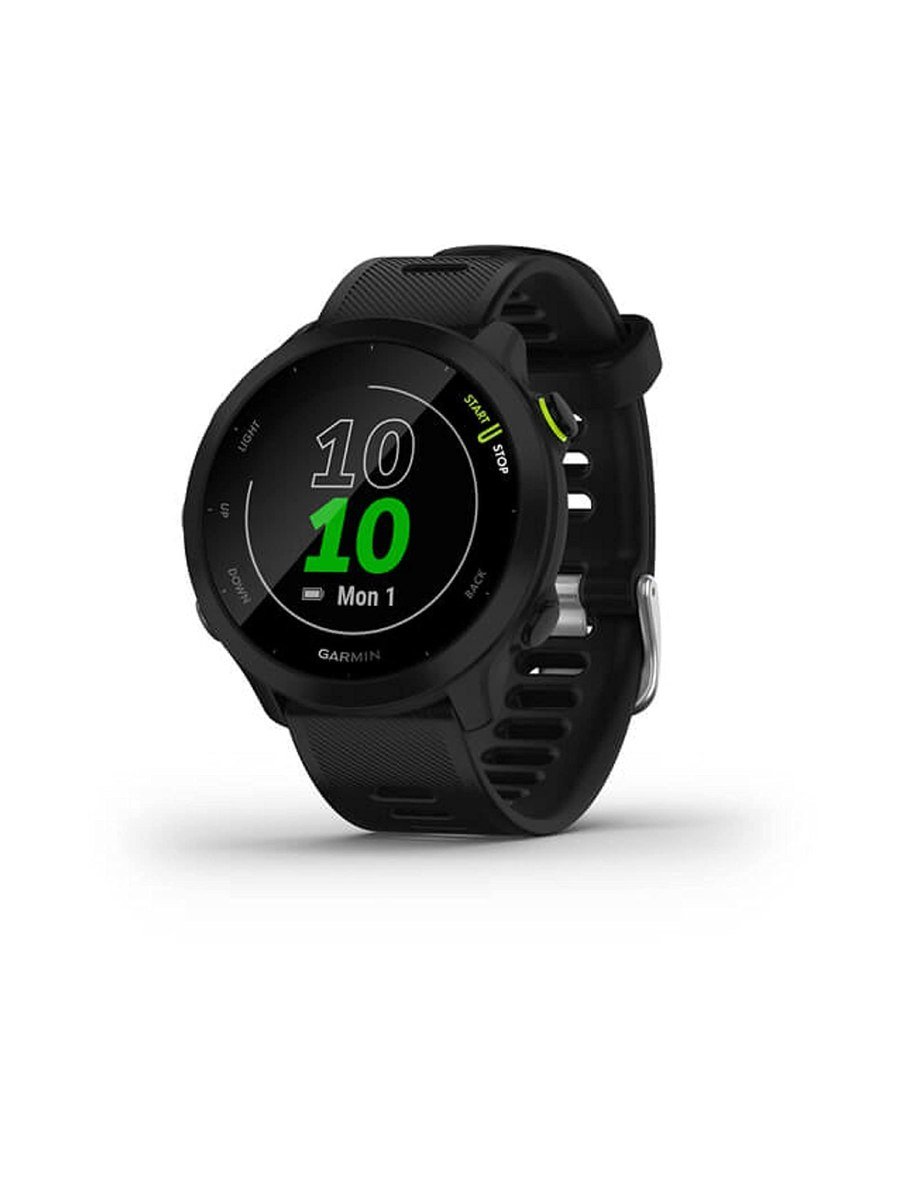
Two weeks of battery, twenty hours of GPS and a daily suggested workout. No maps, no music, no payments, and most runners will not miss them.
- Best for
- Runners who want structure and accurate data without complexity
- Key highlight
- Up to 20 hours of GPS on one charge
- GPS accuracy4.8
- Battery4.9
- Training features4.5
- Screen3.8
- Value4.7
As an Amazon Associate we earn from qualifying purchases. Links on this page may be affiliate links; we may earn a commission at no extra cost to you.
Garmin's entry-level running watch is the one that quietly outlives the expensive ones on a lot of wrists. It does not have maps, it does not have a touchscreen, and it does not have a shop. What it has is accurate GPS, a two-week battery and a training plan that adapts.
Battery, and why it changes things
Up to two weeks in smartwatch mode and up to twenty hours with GPS running. That second figure is the one that matters: it covers a marathon several times over, or a week of daily runs without charging. When a watch charges fortnightly you stop treating it as a device and start treating it as a watch. Anyone moving from an Apple Watch will find this the biggest single difference.
Daily Suggested Workouts
This is the feature that punches above the price. Based on your recent training load and recovery, the watch proposes a specific session each day — an easy forty minutes, or intervals at a target pace. It is not a coach, but for someone who runs regularly without a plan it removes the daily "what should I do today" question and stops the common beginner mistake of running every session at the same medium effort.
PacePro is the other useful one: give it a race distance and a goal time and it produces a pacing strategy that accounts for elevation, then guides you through it on the run.
What it tracks
Running, cycling, track running, virtual running, pool swimming, Pilates, HIIT and breathwork, plus all-day steps, calories, sleep, stress and all-day respiration. Heart rate is wrist-based and fine for steady efforts; like every optical sensor it lags on hard intervals, and a chest strap pairs if you care about that.
What it is not
There are no maps and no breadcrumb navigation beyond back-to-start. The screen is a small memory-in-pixel display — excellent in sunlight, dull indoors, and nobody would call it beautiful. There is no music storage and no contactless payment on this model. Those are the reasons the more expensive Forerunners exist.
Should you buy it?
Buy the 55 if you run and want accurate data, a long battery and structure without complexity. Skip it if you want maps on your wrist, music from the watch, or a device that also works as a smartwatch.
Key features
Daily Suggested Workouts
Proposes a session each day based on training load and recovery.
PacePro
Builds and guides a race pacing strategy that accounts for hills.
Up to 20 h GPS
And about two weeks in smartwatch mode.
Built-in sports profiles
Running, cycling, track, virtual run, pool swim, Pilates, HIIT, breathwork.
All-day health tracking
Steps, calories, sleep, stress and all-day respiration.
Chest strap support
Pairs with an external heart rate strap for interval accuracy.
Pros & cons
What we like
- Two weeks of battery in watch mode, 20 hours with GPS
- Daily Suggested Workouts adapt to your recent training
- PacePro builds a race pacing plan with elevation
- Accurate GPS for the price
- Readable in direct sunlight
- Light and comfortable enough to sleep in
What could be better
- No maps or navigation beyond back-to-start
- No music storage or contactless payments
- Dull screen indoors
Specifications
Frequently asked questions
Yes. Twenty hours of GPS covers any marathon with room to spare, and PacePro gives you a pacing plan for the distance.
No. It offers back-to-start guidance but no maps or turn-by-turn navigation. The higher Forerunner models add those.
No. It controls music playing on your phone but has no onboard storage. The Forerunner 265 and above add that.
Good for steady efforts, less reliable during hard intervals, which is true of every optical sensor. Pair a chest strap if interval accuracy matters.
Yes, it is light and slim, and sleep tracking is one of the reasons to wear it overnight.
Final verdict
Two weeks of battery, twenty hours of GPS and a daily suggested workout. No maps, no music, no payments, and most runners will not miss them.
No comments yet.
Join the discussion. Comments are moderated before appearing.