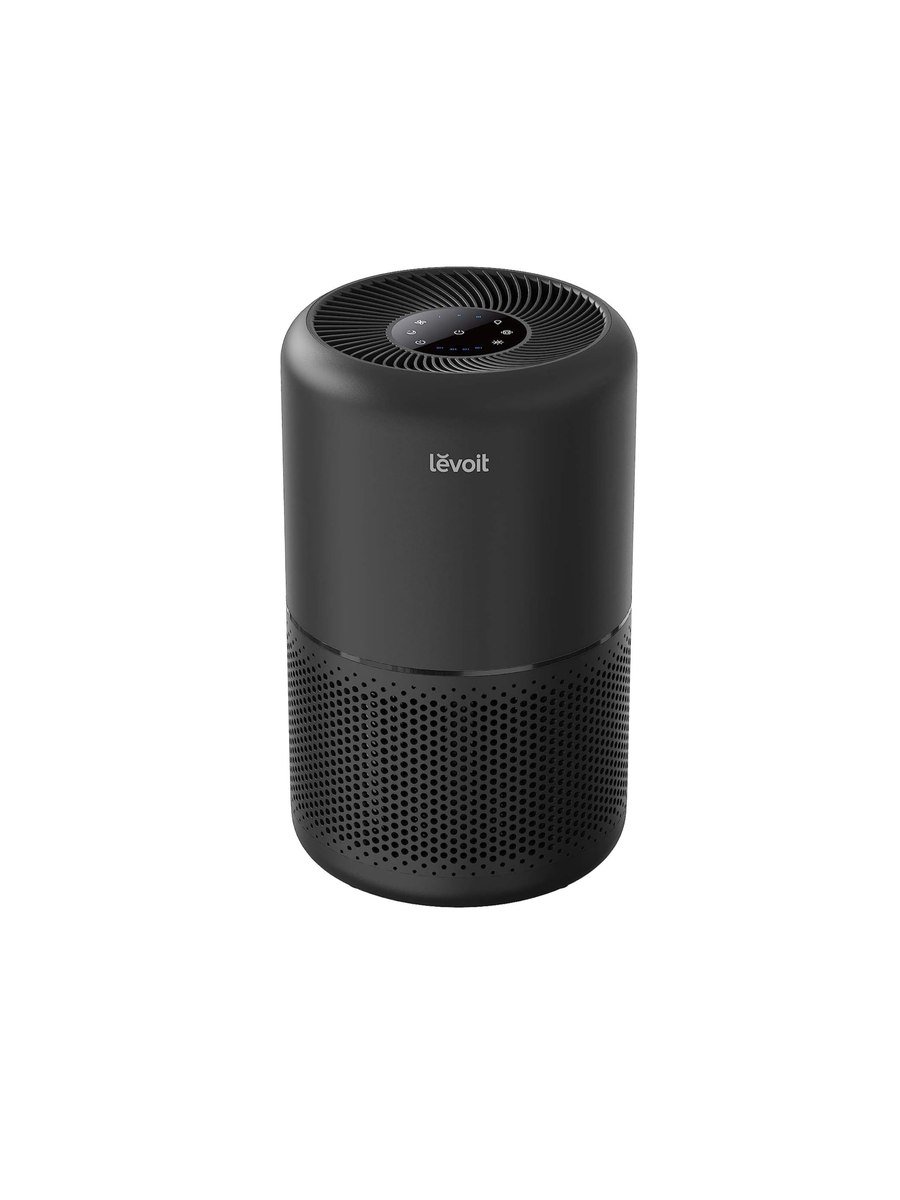
Air purifiers are easy to oversell. Most of what they do is remove particles you can measure — dust, pollen, dander, smoke — and nothing else. The Core 300 does that competently in a bedroom-sized room, quietly, for less money than almost anything comparable.
The filter
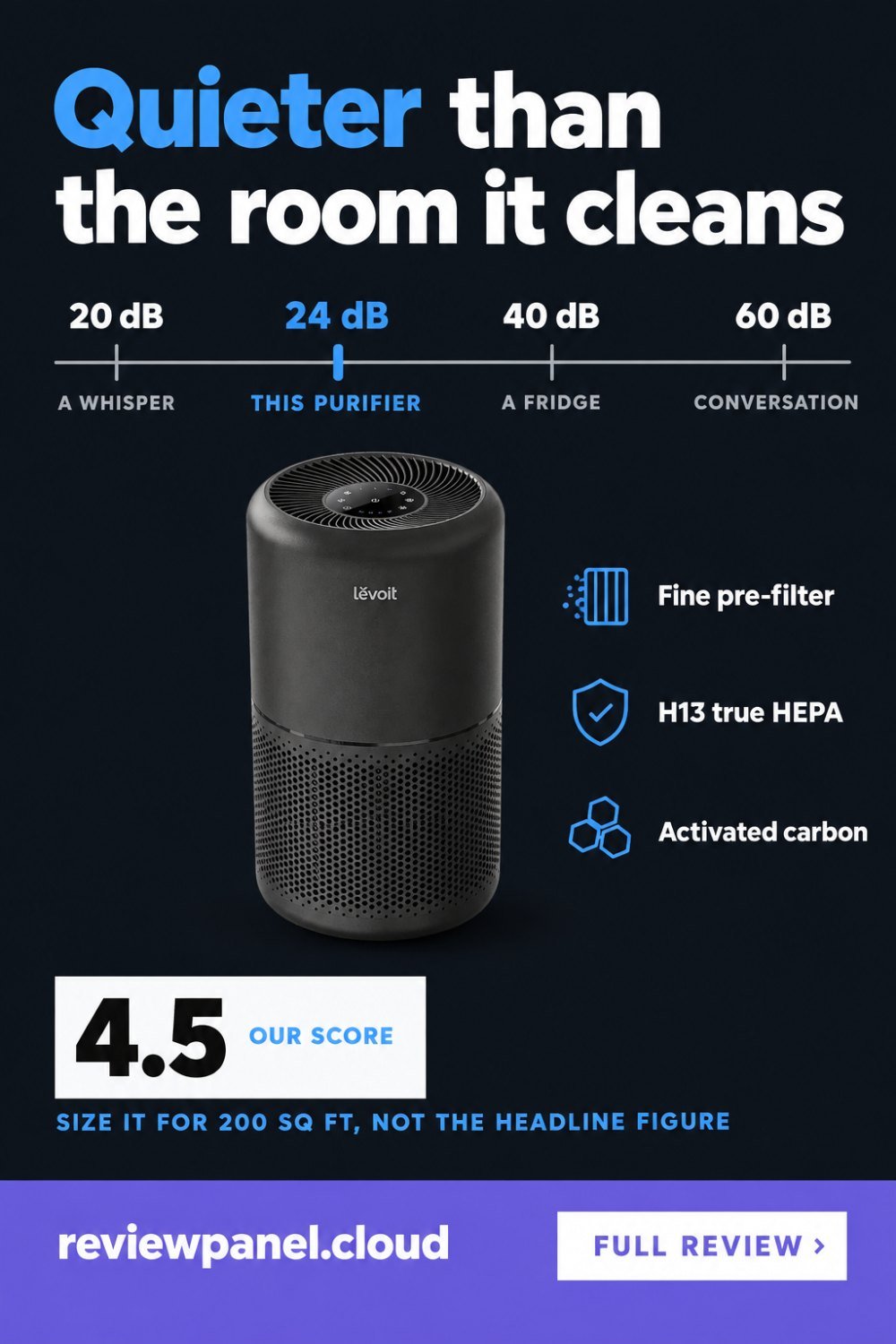
Three stages in one cylinder: a fine pre-filter for hair and large dust, an H13 grade true HEPA layer, and activated carbon for odours. H13 is rated to capture 99.97 per cent of particles at the hardest-to-catch size, and that is the number that matters if you are buying for allergies. The whole assembly pulls out and replaces in about ten seconds, and Levoit recommends changing it every six to eight months.
A word of warning that applies to the whole category: buy genuine filters. The third-party ones are cheaper and their HEPA grade is rarely verified.
Sizing it properly, which is where the box lies
Coverage claims are the least honest number in this category, because a room "covered" once an hour is not a room being cleaned. For allergies you want four or five air changes an hour; for general dust, two or three is enough. The arithmetic is simple and worth doing before you buy anything.
Take the room's floor area in square feet, multiply by the ceiling height to get cubic feet, multiply by the air changes you want, and divide by sixty. That gives the CFM you need. At about 143 CFM, this machine lands like this.
| Room | Air changes an hour | Verdict |
|---|---|---|
| Nursery, 120 sq ft | About 7 | Comfortable, even on medium |
| Bedroom, 200 sq ft | About 4–5 | What the machine is for |
| Home office, 250 sq ft | About 3–4 | Fine for dust, adequate for pollen |
| Living room, 400 sq ft | About 2 | Only useful for general dust |
| Open-plan, 800 sq ft | About 1 | Buy a larger machine instead |
Two rooms of two hundred square feet each want two purifiers, not one bigger one moved between them. Air does not travel around corners on its own.
Coverage and airflow
A 56-watt motor and a quoted 143 CFM CADR. Levoit lists coverage figures over a thousand square feet, which is the number you get with several air changes per hour reduced to one — not a useful way to size a purifier. Treat it as a machine for a bedroom, a nursery or a home office of roughly two hundred square feet, where it can cycle the air several times an hour. In a large open-plan living room it will run flat out and still lose.
Where to put it
Not in a corner, and not against a wall behind a chair. This machine draws air in through its sides all the way round and pushes it out of the top, so anything pressed against it starves the intake. A foot of clear space on every side, somewhere near the middle of the room or near the source of the problem, is worth more than a setting. If it is for hay fever, near the window that gets opened; if it is for a cat, near where the cat sleeps; if it is for sleep, a few feet from the bed rather than beside your head.
Noise
24 dB on the lowest setting, which is genuinely quiet — quieter than most fans and below the noise floor of a typical bedroom. There is a sleep mode that dims the display entirely, which matters if you are sensitive to LEDs at night. On the top setting it is loud, as every purifier is.
What it costs to keep running
Two numbers, and neither is the purchase price. The motor draws 56 watts at full speed and far less on low; left on medium overnight it is a few dollars a year, which is not the part to worry about. Filters are: one or two a year at the manufacturer's price, forever. Over three years the filters usually cost more than the machine did, and that is true of every purifier worth owning. A machine with cheap filters is the cheap machine; a machine with a cheap sticker and expensive filters is not.
The pre-filter layer extends filter life if you vacuum it every month, which takes thirty seconds with the brush attachment and is the only maintenance the machine asks for.
What it does not do
No ioniser, no UV, no ozone — and that is a feature, not an omission. It has no air quality sensor, so it does not adjust automatically; the Core 300S adds Wi-Fi and auto mode if you want that. And it will not help with gases from a new carpet beyond what the thin carbon layer can absorb.
It also does not do anything about humidity, mould behind a wall, or a smell with a source. A purifier removes what is floating in the air at that moment; it does not fix the reason the air is bad. If a room smells damp, the honest answer is a dehumidifier and a builder, not a filter.
Should you buy it?
Buy the Core 300 for a bedroom, a nursery or an office where dust, pollen or pet dander is the problem. Skip it for a large open-plan space, or if you want automatic operation based on a sensor reading.
Key features
Three-stage filtration
Fine pre-filter, H13 true HEPA and activated carbon in one cylinder.
H13 HEPA grade
Rated to capture 99.97% of particles at the hardest size to catch.
24 dB sleep mode
Quiet enough for a bedroom, with the display switched off.
56 W motor
Quoted at 143 CFM CADR.
Tool-free filter change
The whole assembly lifts out in about ten seconds.
No ozone
No ioniser or UV stage, which is the right choice for indoor air.
Pros & cons
What we like
- H13 grade true HEPA layer
- 24 dB on low, with a display-off sleep mode
- Three-stage filter changes in seconds
- No ioniser, UV or ozone
- AHAM Verifide testing on current models
- Filters are reasonably priced
What could be better
- Headline coverage figure is optimistic
- No air quality sensor or auto mode
- Thin carbon layer does little for strong gases
Specifications
Frequently asked questions
Around 200 square feet if you want several air changes an hour. The much larger figures quoted on the box assume a single air change, which is not enough for allergies.
Levoit recommends every six to eight months. Heavy pet or smoke use shortens that.
No. There is no ioniser and no UV stage, which is the right design for a purifier you sleep next to.
They fit, but their HEPA grade is rarely verified. For an allergy purchase, genuine filters are worth the difference.
Not on this model. The Core 300S adds a sensor, Wi-Fi and an auto mode.
Floor area in square feet times ceiling height gives cubic feet. Multiply by the air changes you want, four or five for allergies and two or three for dust, then divide by sixty. That is the CFM to look for. At 143 CFM this machine suits about 200 square feet.
Not in a corner or behind furniture. It draws air in around its sides and pushes it out of the top, so it needs a foot of clear space all round. Put it near the source of the problem rather than tidily out of the way.
Electricity is a few dollars a year. Filters are the real cost, one or two a year, and over three years they usually add up to more than the machine did. That is true of every purifier worth owning.
Final verdict
A quiet, properly filtered purifier for a bedroom-sized room. Ignore the headline coverage figure and size it for about 200 square feet.
What owners report
Gathered from what long-term owners consistently say, not from a single test.
The most common setup mistake is leaving the plastic wrap on the filter; nearly everyone reporting a whistling noise and no airflow on day one has done exactly that. Running it overnight on the lowest setting is not a problem, and no one describes it as sleep-disturbing. Filter replacement cost is what owners talk about most after the purchase, since it adds up against the price of the unit itself. In homes with dust or pets the difference is obvious enough to mention within the first week.
Reader rating
Found this review helpful?
Pin it to one of your boards and come back to it whenever you need a reminder.

No comments yet.
Join the discussion. Comments are moderated before appearing.